

What is ElevenLabs?
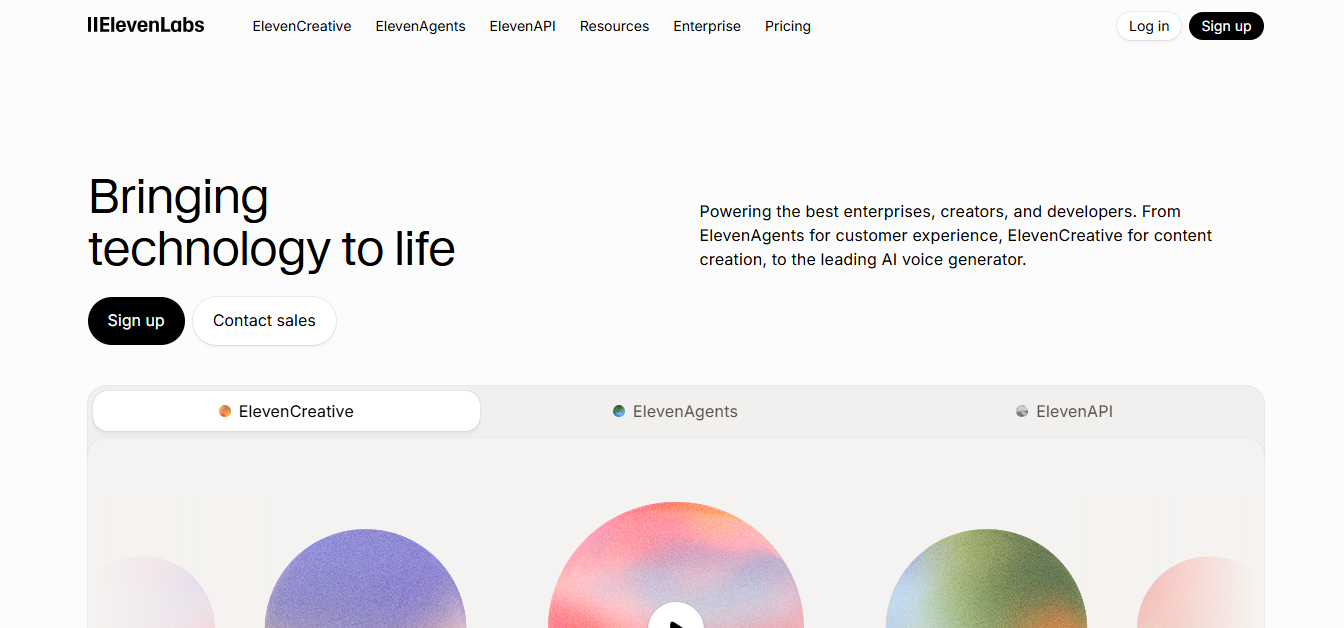
ElevenLabs is an AI voice platform that converts written text into lifelike, emotionally expressive speech. It solves the cost and turnaround problem of hiring voice actors for narration, dubbing, and conversational agents. You can paste a script, pick from 10,000+ voices, and export production-ready audio in minutes. Backed by a16z and Sequoia at $11B.
Key Features
- Eleven v3 model delivers expressive speech in 70+ languages with audio-tag emotion control.
- Instant Voice Cloning replicates a voice from a 1-5 minute audio sample.
- Flash v2.5 model produces speech at roughly 75ms latency for real-time agents.
- Studio editor manages long-form projects with a 10,000-character limit per generation.
- Dubbing automatically translates and re-voices videos across 32+ languages.
Pricing
ElevenLabs runs a freemium model with seven tiers. The free plan blocks commercial use. Paid plans unlock it from Starter onward. Credits scale roughly with TTS minutes generated. Verify current pricing at elevenlabs.io/pricing.
| Plan | Price | Monthly Credits | Approx. TTS Minutes | Best For |
| Free | $0 | 10,000 | ~10 | Testing the platform (no commercial use) |
| Starter | $6 | 30,000 | ~30 | Solo creators needing commercial license + Instant Voice Cloning |
| Creator | $22 ($11 first month) | 121,000 | ~121 | Regular content creators wanting Professional Voice Cloning |
| Pro | $99 | 600,000 | ~600 | High-volume producers needing 192kbps audio + 44.1kHz PCM via API |
| Scale | $299 | 1.8M | ~1,800 | Small teams (3 seats) collaborating on production |
| Business | $990 | 6M | ~6,000 | Larger teams (10 seats) with low-latency TTS from 5¢/minute |
| Enterprise | Custom | Custom | Custom | HIPAA/SSO needs, custom SLAs, priority support |
Prices exclude taxes. Unused credits do not roll over indefinitely. Commercial license starts at Starter. Professional Voice Cloning requires Creator tier or higher.
How It’s Typically Used
A YouTube content creator producing weekly long-form videos:
Step 1: Open the Studio editor inside the ElevenLabs web app.
Step 2: Paste the video script (typically 1,500–3,000 words).
Step 3: Select a voice from the library or use a Professional Voice Clone.
Step 4: Generate MP3 audio with adjusted stability and style settings.
Step 5: Drop the file into the video editor as the narration track.
Pros & Cons
Pros
- Voice quality is widely considered the most natural in the TTS market.
- Audio tags let you control laughs, whispers, sighs, and pauses inline.
- Library of 10,000+ voices covers narration, gaming, conversational, and ads.
- API integrates in under 30 minutes with extensive SDK and Discord support.
- Multilingual cloning lets one cloned voice speak across 32 languages.
Cons
- Credits burn 20-40% faster than estimates once regenerations are counted in.
- Free plan blocks commercial use, forcing paid upgrade for client work.
- Accent drift occurs in longer generations, sometimes mid-sentence.
- Email support takes 3-7 days even on paid plans, with no phone option.
- Production monitoring is limited. Failures stay hidden until callers hit them.
Who It’s For
A YouTube creator or course producer publishing 4+ scripts per month benefits most, since voice quality directly impacts watch-through. Solo creators on tight monthly budgets will find Starter’s 30k credits limiting once regenerations are added. Teams that need sub-100ms latency for real-time voice agents at massive concurrency should evaluate dedicated low-latency providers instead.
Is It Worth It?
ElevenLabs is worth it for content creators publishing regular long-form narration; podcasts, audiobooks, e-learning, and YouTube, where voice realism is the difference between people finishing the content or clicking away.
It is not worth it for an occasional user generating a few minutes of audio per month. Unused credits don’t roll over indefinitely, and the credit math favors consistent producers, not casual experimenters.
Alternatives (Comparison)
Murf AI, Speechify Studio, and WellSaid Labs. Each better suited to different team types, workflows, and budgets depending on whether your priority is voice quality, brand consistency, or studio integration.
| Tool | Core Strength | Best Use Case | Starting Price | Key Limitation |
| ElevenLabs | Most realistic voices, voice cloning at low tier | Creators producing regular narration | $6/month | Credits exhaust faster than advertised |
| Murf AI | Studio editor with Canva and PowerPoint integration | Marketing and e-learning teams | $19/month (annual) | Voice cloning locked to Business+ tier |
| Speechify Studio | Polished UI for non-technical creators | Solo creators wanting simple voiceover | $19/month (annual) | Hours capped annually, not monthly |
| WellSaid Labs | Brand voice consistency and enterprise security | Corporate e-learning at scale | $49/month (Maker) | English-only, no multilingual support |
FAQs
Is ElevenLabs free to use commercially?
No, the free plan explicitly prohibits commercial use. You need the Starter plan at $6/month or higher to use generated audio in monetized videos, client work, or paid products.
Does ElevenLabs support voice cloning on entry-level plans?
Yes, Instant Voice Cloning is available from the Starter plan at $6/month. Professional Voice Cloning, which captures finer detail from 30+ minutes of source audio, requires the Creator plan at $22/month.
ElevenLabs vs Murf AI – which is better for solo creators on a tight budget?
ElevenLabs is the stronger fit for budget-conscious solo creators because voice cloning starts at $6/month, while Murf AI restricts cloning to Business and Enterprise tiers. Murf becomes more competitive for teams needing Canva or PowerPoint integration.
Is ElevenLabs reliable for real-time voice agents?
Yes, the Flash v2.5 model delivers roughly 75ms latency, fast enough for most voice agent applications. Teams requiring sub-50ms latency at high concurrency may prefer purpose-built infrastructure providers.
How many languages does ElevenLabs support?
ElevenLabs supports 70+ languages on the Eleven v3 model and 32 languages on Multilingual v2. English voice quality is the most polished; non-English output occasionally suffers from accent drift in longer generations.