
Before you pay for Info Tracer, the real question isn’t whether it works. It’s whether the data is current enough to trust, and whether you’re even legally allowed to use it for what you have in mind. Most reviews skip both.
InfoTracer is a legitimate paid people-search service – not a scam, but also not free, and not built for the “official” background check most people assume. It sells one package: 7 days of unlimited access for $2.95, which then auto-renews at $24.95 per month unless you cancel. The biggest risk here isn’t security. It’s that trial-to-subscription handoff, and a legal limit that rules the tool out entirely for some uses.
This review covers what you actually get, what it truly costs, how reliable the records are, the one legal line that should decide it for you, and how to cancel without getting burned.
What Info Tracer actually is (and who runs it)
Info Tracer is a data-broker search engine. You enter one detail about a person, and it assembles what it can find from public and commercial sources into a single report. You can search by name, phone, email, username, address, license plate, VIN, and IP address.
Is it a real company? Yes. It’s operated by InfoPay, Inc., which does business as InfoTracer and is an approved NMVTIS data provider, the federal motor-vehicle title system, which is a genuine authority signal and matters later for vehicle searches.
InfoTracer claims it can search more than 5 billion records. That’s their own number, though – not something checked by anyone else. So treat it as a sales pitch, and judge the tool by what a report actually shows you, not by that figure.
So why pay for this instead of just Googling someone? Because it pulls scattered public records – court, criminal, property, vehicle – into one place in seconds, which a manual search can’t easily do. The catch is that convenience doesn’t guarantee accuracy. And one detail most people miss: InfoTracer doesn’t notify the person you looked up, which also means someone can search you without you ever knowing.
What using InfoTracer actually feels like
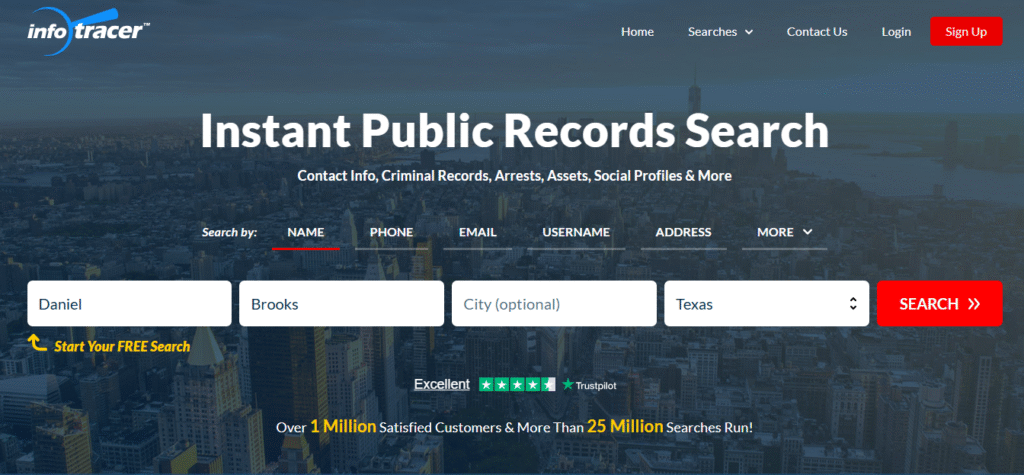
I ran a search to see how it works. You enter the person’s first name, then last name, with city optional and state to narrow it down, then hit search. A progress screen takes over, claiming to scan billions of records. Then the results page loads, and it’s blurred. You can see that a record exists, sometimes with a partial location or age, but every real detail is locked.
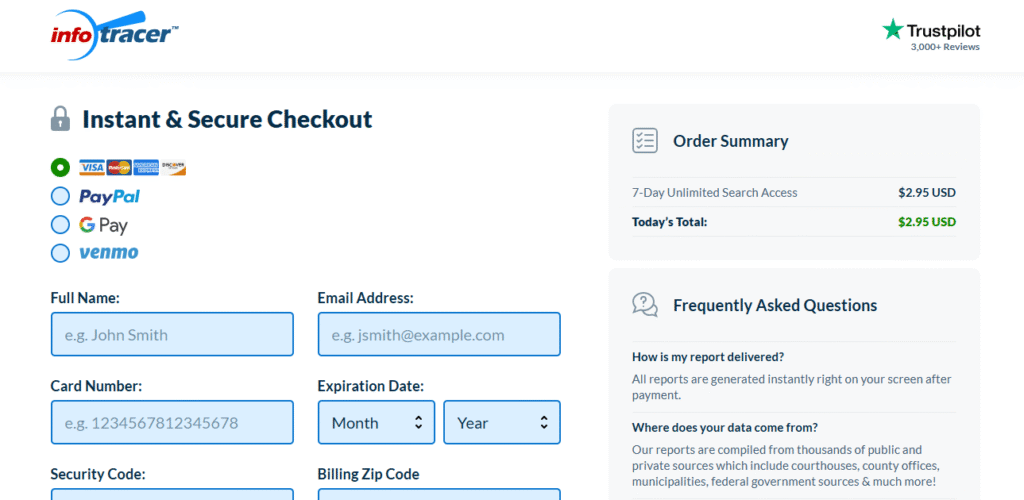
That’s the moment the pitch appears: unlock everything with the $2.95 seven-day trial. Before checkout completes, you have to tick a box agreeing to the billing terms, which is where the auto-renewal lives. Pay, and the full report renders instantly on screen rather than arriving by email.
It’s a smooth flow, deliberately so. The friction isn’t in getting in. It’s in remembering to get out before day eight.
Is InfoTracer free?
The short answer is no.
This is the most-searched question about the service, so let’s settle it. InfoTracer is not free. The search box will confirm a record exists, but every meaningful detail sits behind a paywall.
Here’s the current pricing:
| Option | Price | What you get |
| 7-day trial | $2.95 | Unlimited searches for 7 days |
| Then monthly | $24.95/mo | Unlimited searches and reports, auto-renews until canceled |
Trial price is promotional and may vary by offer or landing page. Check the exact amount on your own checkout screen before paying.
The trap is the handoff. The trial converts to $24.95 a month after seven days unless you cancel, and that single line explains the bulk of the angry InfoTracer reviews online. People forget, and the charge lands.
What’s actually in the Info Tracer report
Before paying $24.95, it helps to know what you’re buying. A full InfoTracer report is organized into a handful of sections, though how much each one returns depends entirely on the person and the public records available.
Based on the live report layout, you can expect to see categories for contact details (phone numbers, emails, usernames, addresses), social and web results, court records (criminal, bankruptcy, liens, driving violations), public records (marriages, divorces, and similar), assets like real estate and vehicles, and professional history.
The reality: those are the possible fields, not a guarantee. For some people you’ll get a dense report; for others, half the sections come back thin or empty. Which brings us to the question that actually decides value.
How accurate is the data, really?
This is where InfoTracer gets shaky, and long-term users are blunt about it. They describe results that have grown outdated, cluttered with vague or mismatched records, and prone to duplicates under slightly different names, with several saying quality has declined.
Vehicle data draws the sharpest criticism. One buyer ran a car through InfoTracer, got a report showing no theft record, then learned from another service that the vehicle was actively reported stolen. The VIN check itself is NMVTIS-backed, so it’s more credible than a random aggregator’s, but it’s a starting point, not the final word. Verify against a full title/history report before you buy.
What about the info tracer plate or VIN lookup? Both exist as live search types, but keep expectations modest. Users report the plate lookup won’t reliably return a vehicle owner’s name. For a single specific lookup, confirm what the result will actually include before you subscribe.
The honest read: InfoTracer is fine for a rough, low-stakes picture of someone. It’s not reliable enough to base a real decision on, which leads straight to the thing almost no review mentions.
The legal line: FCRA
This matters more than the price. InfoTracer states it is not a consumer reporting agency under the Fair Credit Reporting Act, and explicitly prohibits using its results to judge a person’s eligibility for credit, insurance, employment, housing, or a government license or benefit.
In plain English: you cannot legally use InfoTracer to screen a job applicant, vet a tenant, or make a credit or insurance call. The company holds no FCRA accreditation and discloses this directly.
So if you’re a small-business owner thinking “I’ll just run applicants through InfoTracer,” stop – that’s the exact use it forbids. For hiring or tenant screening you need an FCRA-compliant provider, which is a different category of tool.
How to cancel your InfoTracer subscription without getting burned
Is InfoTracer hard to cancel? Officially no, in practice sometimes. InfoTracer says its call center is open 24/7 and that you can cancel with one click from your account page, and the published number is (800) 791-1427, with fees billed monthly in advance and no refund on the unused portion of a month.
The friction shows up in execution, the on-site action doesn’t always seem to register, and people end up phoning or emailing to make it stick. Some customers report trouble reaching support and resort to third-party cancellation tools.
A practical playbook for an info tracer cancel subscription that holds:
- Cancel inside the trial window, not after. Set a phone reminder for day 6.
- Use the account page and the phone line, and keep the confirmation email.
- Screenshot the cancellation screen and any confirmation number.
- If a charge still lands, request a reversal in writing, refunds are commonly granted when you haven’t used the service.
The fair flip side: support does resolve many of these. Reviewers frequently describe prompt refunds and helpful agents once they reach a person. You just have to reach one.
There’s one more cancellation many readers don’t realize they want – removing their own data.
Your data is probably in there too
If InfoTracer can show you a stranger’s address and phone number, it can show a stranger yours. It catalogs current and past addresses, phone numbers, email addresses, relatives, and more from public records.
You can opt out. InfoTracer provides an opt-out form at infotracer.com/optout and a privacy contact at privacy@infotracer.com, with email verification. A tip from privacy specialists: use a throwaway email, since contacting any data broker can land you on a marketing list. And public-records data can reappear later as new sources publish it.
There’s also a newer shortcut. As of January 2026, California residents can submit a single centralized request to opt out across registered data brokers at once, instead of opting out of each site one by one. If you’re eligible, that’s far less tedious than chasing individual forms.
If privacy is your only reason for being here, opting out is free and worth doing whether or not you ever subscribe.
InfoTracer vs the alternatives
If you’ve decided it isn’t the fit, here’s where to look. One thing to be clear about first: none of the consumer people-search tools below are FCRA-compliant. Only dedicated screening services are.
| Service | Typical cost (USD) | FCRA-compliant? | Best for |
| InfoTracer | $2.95 trial → $24.95/mo | No | Broad personal lookups |
| BeenVerified | ~$26.89–$36.89/mo month-to-month, lower on 3-mo plans; $1 trial common | No | Frequent personal searches |
| TruthFinder | ~$28.78/mo, ~$23/mo on a 3-mo plan | No | Deeper criminal/identity data |
| TruePeopleSearch / FastPeopleSearch | Free | No | Basic name, address, phone |
| Checkr / GoodHire | Per-report business pricing | Yes | Employment & tenant screening |
Competitor pricing verified June 2026; consumer people-search prices shift frequently with promos and location.
A simple decision lens:
- One-off or curiosity: A free InfoTracer alternative like TruePeopleSearch first.
- Frequent personal searches: A paid subscription, price-shopped against BeenVerified and TruthFinder.
- Any formal screening: An FCRA-compliant provider only.
Here’s how that plays out for real people.
A few real-world scenarios
A woman keeps getting calls from an unknown number and runs a reverse lookup. That’s an allowed, low-stakes use, though a free tool might answer it too.
A man vetting a used car runs an info tracer VIN check and sees a clean record. Because the VIN data is NMVTIS-backed, it’s a reasonable first pass, but he still pulls a full title/history report before paying, exactly the gap the stolen-vehicle case exposed.
A café owner considers InfoTracer to screen a new hire and save money. This is the trap, the prohibited use case. The responsible move is an FCRA-compliant screening service.
Conclusion
The honest verdict from this InfoTracer review: it’s a legitimate people-search tool, useful for casual, personal lookups, and the wrong choice for anything that legally counts. The data is hit-or-miss, the $24.95 subscription sits at the pricier end, and nearly every complaint traces back to the trial quietly converting to a monthly charge.
If you try it, set a cancellation reminder for day six and keep your confirmation. If your goal is screening a hire or tenant, don’t start here. And if you’re only here because your own data showed up, opt out – it costs nothing.
FAQs
Is InfoTracer free?
No. InfoTracer is not free. It offers a 7-day trial for $2.95 that converts to $24.95 a month unless canceled, and full reports always sit behind a paywall. The free search only confirms a record exists.
Is InfoTracer hard to cancel?
Officially it’s easy, but in practice it can be frustrating. InfoTracer says you can cancel 24/7 by phone or with one click from your account page, yet several users report the on-site action not registering, so confirm by phone at (800) 791-1427 and save proof.
InfoTracer vs BeenVerified – which is better?
For most casual users, BeenVerified offers fresher data and a cleaner interface, while InfoTracer wins on the sheer breadth of search types. BeenVerified’s month-to-month price typically runs higher (around $26.89 to $36.89), dropping on a three-month plan, versus InfoTracer’s flat $24.95. Neither may be used for FCRA-regulated screening.
Can I use InfoTracer for a background check on a job applicant?
No. InfoTracer is not a consumer reporting agency under the FCRA and prohibits using its data for employment, tenant, credit, or insurance decisions. Use an FCRA-compliant screening provider instead.
Does InfoTracer offer a VIN or license-plate lookup?
Yes, and the VIN check is NMVTIS-backed, which adds credibility. VIN, plate, email, and IP are all live search types, though users report the plate lookup won’t reliably return a vehicle owner’s name. Verify any VIN against a full title report before a purchase.
Is InfoTracer legit and safe to use?
Yes, it’s operated by InfoPay, Inc., a real company. It holds an A+ rating from the Better Business Bureau, and you only enter publicly available information. The main risk is billing, not security.