
KEY TAKEAWAYS
- Cost: Credit-based plans from $49/mo (Basic) to $900/mo (Enterprise); ~30% off annual
- Free trial: Yes, 500 credits, sometimes a $1 / 3-day trial; auto-converts to paid
- Refunds: No refund policy; common post-trial charge complaints on Trustpilot
- Best for: TikTok-first dropshippers and media buyers who’ll use it regularly
- Skip it if: You need multi-platform coverage or verified store-revenue data
Most of what’s written about Pipiads online is selling you something, a cheaper alternative, a discount coupon, or a “group buy” link. So here’s the thing almost no review will tell you up front, and I think you’ll be glad you caught it: Pipiads quietly changed its entire pricing model in 2025, and a year on, nearly every Pipiads review online still lists the old pricing.
Pipiads is a TikTok-first ad spy tool. You use it to see which TikTok (and now Facebook) ads are running, which products are selling, and how your competitors structure their campaigns, so you can find winning products before they saturate. That’s the short version. The longer version is messier, and the mess is exactly where buyers lose money.
I know what you’re really here to find out: what it actually costs now, whether the free trial is a trap, and whether you can trust it with your card. We’ll cover all three, including why its G2 reviews and its Trustpilot reviews tell two completely different stories. No coupon links. No pitch.
The misconception that costs people money
The most common mistake isn’t choosing Pipiads over a competitor. It’s misreading what an ad spy tool proves, and I’d bet you’ve half-believed this one yourself.
Pipiads shows you what’s being advertised. It does not, on its own, prove what’s profitably selling. A TikTok ad with huge view counts can sit on top of a store that’s bleeding money on ad spend. Treating “lots of impressions” as “validated winner” is how dropshippers burn their first few hundred dollars testing products that were never profitable to begin with.
Used correctly, Pipiads is a discovery and inspiration engine, a way to spot patterns, hooks, and emerging products early. The validation has to come from you. Keep that frame and the tool earns its cost. Forget it, and no subscription tier will save you.
So the real question isn’t “is Pipiads good?” It’s “is Pipiads the right kind of tool for how I actually work?” That starts with understanding what you’re paying for.
How Pipiads pricing actually works in 2026
Quick context, because most “2026” reviews get this wrong: in August 2025 Pipiads dropped its old Starter/VIP/Pro tiers for a credit-based “2.0v” model. Pre-2025 subscribers were grandfathered in; everyone else now buys credits. The logic is simple: 1 credit = a basic data point, ~20 credits = a full ad breakdown. Credits reset monthly and don’t roll over.
The four current plans (USD, monthly):
| Plan | Price/mo | Credits | Users | Ad trackers | Best for |
| Basic | $49 | ~10k–30k* | 1 | 2 | Solo dropshippers |
| Advanced | $99 | 100,000 | 1 | 10 | Most pros / small agencies |
| Flexible | $180+ | 200,000+ | 2+ | 20+ | Scaling teams |
| Enterprise | $900 | 1,000,000 | 10 | 100 | Multi-account teams |
Pricing last verified: June 2026. Sources split on the Basic credit count (10k vs 30k); confirm on the official Pipiads pricing page before subscribing.
Two things the price table won’t tell you: annual billing saves about 30% (ignore the “up to 60%” coupon-post hype), and the AI Tools suite is a separate add-on from $11.99/mo, not bundled in.
Most solo users and small agencies are fine on Basic or Advanced. The $900 Enterprise tier is where people overpay for capacity they never touch.
What the free trial actually looks like
We signed up and ran the free trial so you know exactly what to expect.
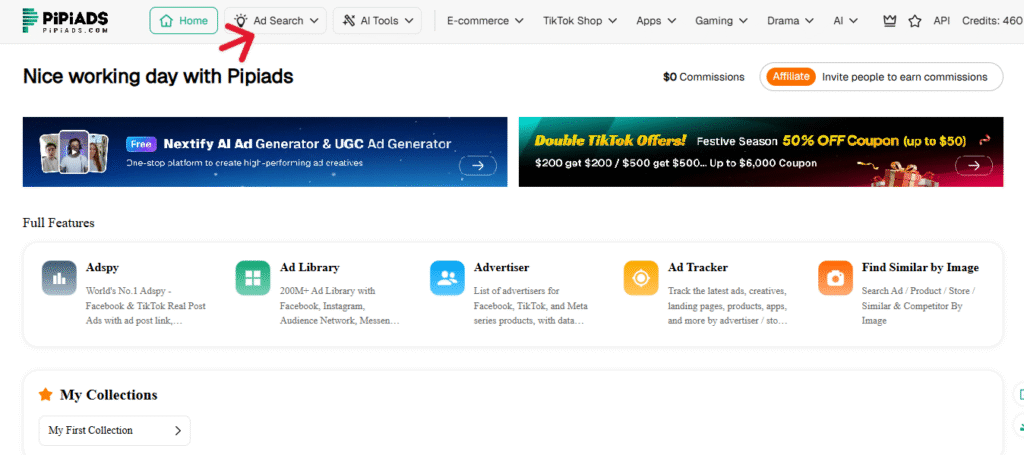
Login is straightforward – Google sign-in works, no friction. Once inside, the dashboard gives you quick access to Ad Search, Ad Library, Advertiser lookup, Ad Tracker, and a “Find Similar by Image” tool. The interface is clean and not overwhelming for a first-time user.
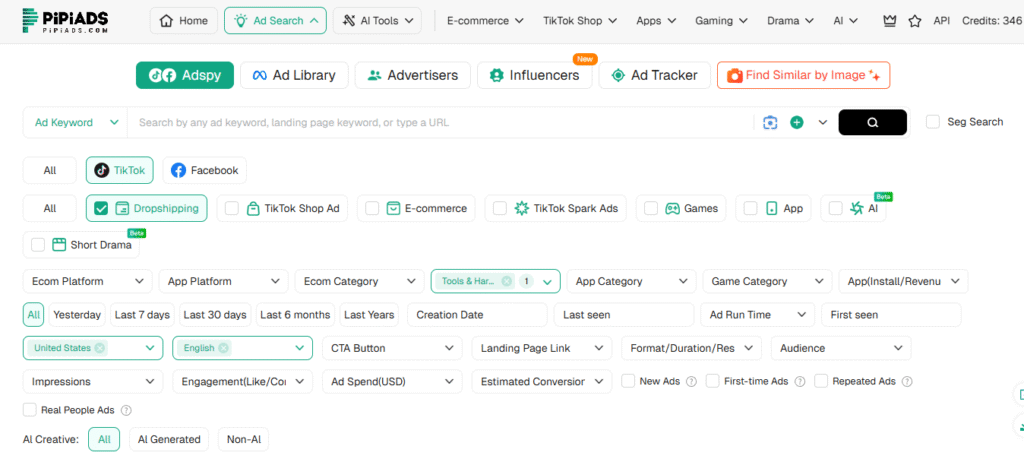
Clicking into Ad Search is where it gets interesting. The filter depth is genuinely impressive: you can narrow by platform (TikTok or Facebook), ad type (Dropshipping, TikTok Shop, E-commerce, Spark Ads, Games, App, and more), country, language, date range, CTA button type, ad format, audience demographics, impressions, engagement, estimated ad spend, and estimated conversions. Most ad spy tools give you five or six filters. Pipiads gives you closer to twenty.
Here’s the catch with the free trial though, and this is important. You start with 500 credits. They go faster than you’d expect. We had 312 credits left after a basic search session, meaning roughly 188 credits disappeared quickly just browsing. At 20 credits per detailed ad breakdown, 500 credits gets you about 25 full analyses before you hit zero.
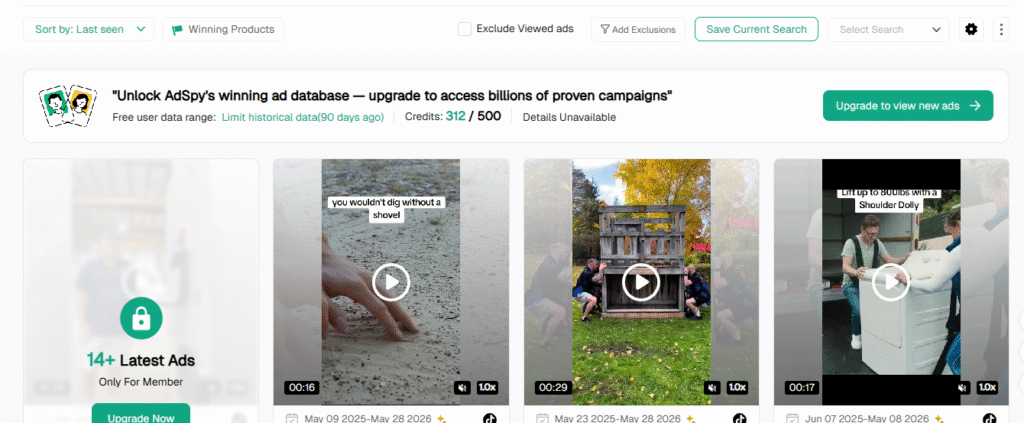
The results themselves are useful but gated. Free users get a 90-day data limit, and the most recent ads are locked behind a paywall, the first result we saw showed “14+ Latest Ads, Only For Member” with an Upgrade prompt. Scroll past that and you do get real visible ads with dates, thumbnails, and basic metrics.
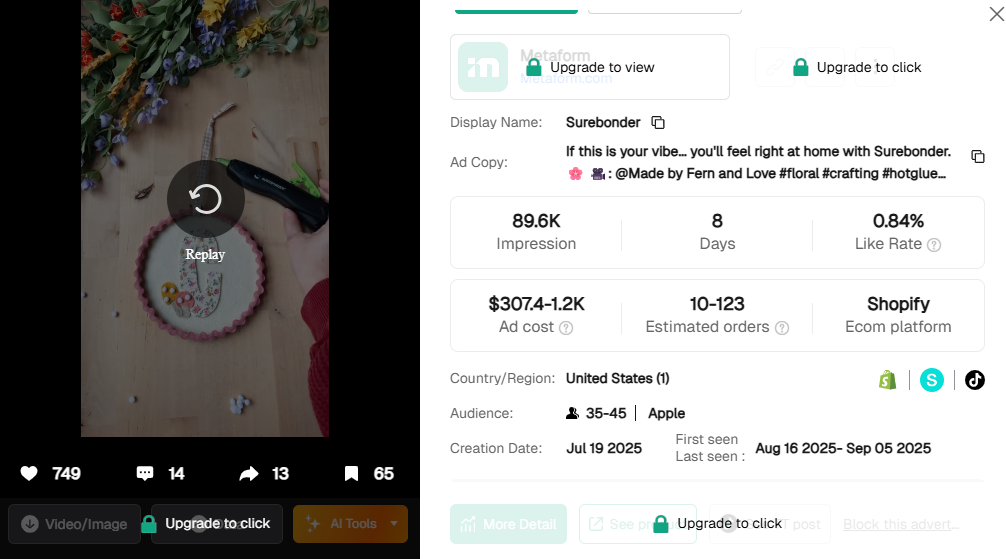
When you click an ad, the detail panel shows you everything that matters for a buying decision: impression count, days the ad has been running, like rate, estimated ad spend range, estimated orders, the e-commerce platform (Shopify in the example we tested), country, audience age range and device, and the exact creation and last-seen dates. That last detail, knowing whether an ad is still actively running, is genuinely valuable.
For anything deeper (the advertiser’s full profile, the landing page link, similar ads), you hit an “Upgrade to click” wall. That’s the honest free-trial ceiling: enough to validate that the data quality is real, not enough to do serious product research.
Refunds, trust, and the review gap
Here’s the contradiction at the heart of Pipiads’ reputation. On G2, verified users are largely positive, with recurring praise for cutting research time, solid real-time TikTok and Facebook data, and launching ads faster. On Trustpilot, the picture flips: a cluster of complaints about being charged after a trial, slow email support, and refund requests being met with offers of “extra free months” instead of money back.
Both can be true at once. People who use the product daily tend to value it. People who got auto-charged on a forgotten trial, and then hit Pipiads’ published no-refund policy, tend to feel trapped. The tool’s quality and its billing experience are two separate things, and most reviews only tell you about the first.
If reading that gave you a flicker of caution, trust it – you thought right. Here’s what to do with it: treat Pipiads as a no-refund purchase, because that’s what it is.
Don’t enter card details until you’ve decided you want it. Use the trial to evaluate, cancel deliberately, and only then subscribe with intent. That uneasy feeling is data. Respect it.
Is that a dealbreaker? Not necessarily. Plenty of SaaS tools run hard no-refund policies. But going in informed is the difference between a tool you chose and a charge you’re fighting.
Once you’re past the buying decision, the day-to-day value comes down to the features and their real limits.
What Pipiads does well (and where it stops)
The core of Pipiads is its TikTok ad database. You search and filter ads by keyword, category, country, call-to-action, publish date, impressions, engagement, and e-commerce platform. A dedicated Product Search surfaces newly launched products, and a Winning Products view collects top performers by engagement and estimated orders.
The Pipiads Chrome extension is genuinely useful: visit a Shopify store and it surfaces that store’s top products plus traffic and sales signals. The catch, and I’d hate for you to learn this mid-research, is that it only works on Shopify. Land on a WooCommerce or custom store and you get nothing. Niche filtering is also limited; you’ll filter by keyword and date more than by tidy categories, which makes deep niche research more manual than it should be.
Coverage is the other boundary. Pipiads is TikTok-first by design. Facebook coverage has grown, but Instagram, Pinterest, and YouTube are thin or absent. If TikTok is your battlefield, that focus is a feature. If you’re running multi-platform, it’s a gap you’ll have to fill elsewhere.
You’re probably wondering how big the database really is. Pipiads markets itself as the largest TikTok ad library, citing 50 million-plus creatives; some third-party write-ups put the figure lower, around 20 million. Either way it’s large, but “largest” is the company’s own claim, not an independently audited number, so weigh it as marketing.
Some critics (often rival tools) say Pipiads’ data can run a few days behind. Its database updates daily, so most people won’t notice. But if you chase fast trends that peak in a day or two, test how fresh the data feels during your free trial before you rely on it.
Those strengths and limits are exactly why so many people start looking at alternatives.
Group buy, affiliate program, and API
A lot of people searching “pipiads” are really searching for a way around the price, and I get it.
A Pipiads group buy means splitting one account across strangers through a third-party reseller. It’s cheaper, and it’s a bad idea. It typically violates the terms of service, can get the shared account banned, leaves you with no real support, and exposes your login activity to people you don’t know. The savings rarely survive a single ban; that “deal” can cost you more than the subscription would have.
The Pipiads affiliate program is legitimate and is how many “reviews” get funded – Affiliates earn commissions on referrals. That’s not disqualifying, but now you know why so much coverage skews glowing. (Worth noting: some affiliates have publicly complained about delayed commission payouts, so do your own diligence if you plan to promote it.)
API access exists, but it’s not a self-serve feature on standard plans. It’s handled through custom Enterprise arrangements. If programmatic data access is core to your workflow, you’ll be talking to their sales team, not toggling a setting.
For most readers, none of these shortcuts change the core decision: pay the standard price, or pick a different tool.
Pipiads Alternatives
No single tool wins for everyone. The right pick depends on how you actually work.
The two tools people compare most are Pipiads and Minea, so here’s the head-to-head first:
| Feature | Pipiads | Minea |
| Primary focus | TikTok-native ad + product data | Multi-platform product discovery |
| TikTok coverage | Core feature, entry tier | Premium tier only (~$99/mo) |
| Entry plan | Basic $49/mo | Starter $49/mo ($34 annual), Facebook ads only |
| Platform breadth | TikTok-first, Facebook secondary | Facebook, TikTok, Pinterest (higher tiers) |
| Database depth | Deepest for TikTok | Broader, shallower per platform |
| Store spying | Chrome extension, Shopify only | Chrome extension, works across store types |
| Refunds | No refunds | No refunds |
| Best fit | You compete mainly on TikTok | You want one tool across channels |
The entry prices look identical at $49, but here’s the catch most comparisons miss: Minea’s cheapest tier is Facebook-only. To get the TikTok coverage that’s Pipiads’ whole reason for existing, you’re stepping up to Minea Premium at roughly $99/mo. So if TikTok is your game, Pipiads is the cheaper way in. If you want one tool spanning Facebook, TikTok, and Pinterest, Minea earns the higher spend.
The wider field, and who each one fits:
| Tool | Pick it if… | Coverage |
| Pipiads (stay) | TikTok is your primary channel and you want the deepest TikTok data | TikTok-first |
| Minea | You want broad coverage across channels; good beginner all-rounder | Facebook, TikTok, Pinterest |
| TrendTrack | You want ads linked to real Shopify store revenue, not engagement | TikTok, Facebook + store revenue |
| BigSpy | Budget is the hard limit; wide, shallow coverage to start | 9+ platforms (surface-level) |
| AdPlexity / Anstrex | You’re an affiliate or media buyer needing native, push, or landing-page intel | Native, push, mobile, e-com |
The decision rule: match the tool to your primary platform, and to whether you need creative inspiration or revenue validation. Buying the most popular tool instead of the right-fit one is the most expensive mistake in this category, and now you won’t make it.
Common mistakes to avoid with Pipiads
A freelance dropshipper on the Basic plan treats every high-view ad as a winner, tests five of them, and loses money on four because she validated on impressions, not orders. The fix was free: cross-check against store signals before spending.
A small agency buys Enterprise for the seats, then uses a fraction of a million credits a month, paying for capacity it never touches. Flexible or Advanced would have done the job.
And the most common one, and be honest, you can see yourself doing this: forgetting to cancel a trial, getting auto-charged, and discovering the no-refund policy the hard way. None of these are tool failures. They’re avoidable buyer errors, which is the whole point of you reading this before you subscribe.
Conclusion
Pipiads is a strong, focused tool that does one thing better than almost anyone: TikTok ad and product intelligence. The product isn’t the risk; the buying experience is, a no-refund policy and a trial that auto-charges. Go in knowing that, and it’s a fair deal.
If TikTok is where you compete, Pipiads earns its place in your toolkit. If you need multi-platform coverage or verified revenue data, an alternative will serve you better. Either way, the data quality is real, just go in with clear expectations.
FAQs
Is Pipiads worth it in 2026?
Pipiads is worth it if TikTok is your primary advertising channel and you’ll use it regularly. Its TikTok ad and product database is among the deepest available, and daily-active users consistently report it cuts research time. It’s harder to justify for occasional users or multi-platform marketers, given its TikTok-first focus and strict no-refund billing.
How much does Pipiads cost?
Pipiads runs on a credit-based model with four plans: Basic at $49/month, Advanced at $99/month, Enterprise at $900/month, and a Flexible plan from about $180/month. Annual billing cuts roughly 30%. The AI Tools suite is a separate add-on starting around $11.99/month, and yes, that catches people off guard, so factor it in.
Does Pipiads offer a free trial?
Yes. Pipiads typically offers a free trial with 500 credits, and sometimes a promotional $1 three-day full-access trial. That’s enough to test the interface but not to complete serious product research. Trials convert to paid plans automatically, so cancel before conversion if you don’t intend to continue.
Does Pipiads give refunds?
No. Pipiads operates a no-refund policy on its plans and credits, and user complaints about post-trial charges are common on Trustpilot. Treat any purchase as final and only enter payment details once you’ve decided to commit. If that gives you pause, that instinct is worth listening to.
What is the best Pipiads alternative?
The best alternative depends on your need: Minea is the strongest all-rounder for multi-platform coverage, TrendTrack suits those who want ads linked to real Shopify revenue, and BigSpy is the budget option. Pipiads remains the leader specifically for TikTok-native ad data, so “best” is a function of your primary platform.
Is Pipiads good for beginners?
Yes. Pipiads is beginner-friendly thanks to a clean dashboard and a ready-made Winning Products view that removes much of the guesswork. The main beginner pitfall is mistaking high ad engagement for proven profitability, so new users should always validate a product beyond impression counts before testing it.