

Here is the uncomfortable truth about why most AI written content does not rank. The problem is usually not the writing. It is everything that happens before the writing starts.
If you do not understand what a searcher actually wants when they type a query, not just the keyword but the intent behind it, no amount of polished prose gets you to page one. Most AI writing tools are built to make the writing faster. They do not touch the strategy underneath it.
The five tools in this article are different. They exist to close the gap between “I published something” and “I ranked for something.” They handle keyword research, search intent analysis, content structure, and on page optimization, not just word generation. They do not all solve the same problem either. Some run the full workflow from research to draft. One is built purely for optimizing what you have already written. One focuses almost entirely on finding keywords a smaller site can realistically win. Matching the tool to your actual bottleneck matters more than picking the one with the longest feature list.
Key takeaways:
- If your keyword strategy is broken, fix that first. RankIQ is built for exactly that.
- If research is your bottleneck, Frase cuts that time significantly.
- If you are writing but not ranking, Surfer tells you what is structurally missing.
- If you want one platform that does everything, Scalenut is the most complete option.
- If budget is the constraint, NeuronWriter gives you Surfer-level data at a fraction of the cost.
How We Evaluated These Tools
We evaluated each tool based on hands-on use, verified pricing pulled directly from each tool’s official page in July 2026, and G2 review data cross-checked. We used Scalenut ourselves to create a full article: Cruise Mode produced a 3,215 word draft with a content score of 86 out of 100, which gave us a concrete baseline for evaluating its output quality. For the remaining tools, our evaluation is based on feature verification, pricing confirmation, and G2 review analysis. No tool paid for placement.
Quick Comparison
| Tool | Best For | G2 Rating | Free Trial | Starting Price |
| Scalenut | Full SEO workflow, content briefs | 4.7/5 (316 reviews) | Yes | $24/month (promo), $59/month standard |
| Surfer SEO | Real time on page optimization | 4.8/5 (545 reviews) | Yes | $99/month billed yearly, $119/month billed monthly |
| Frase | Research and brief generation | 4.8/5 (309 reviews) | Yes, 7 day, no card | $39/month billed yearly, $49/month month to month |
| NeuronWriter | Budget conscious bloggers | 4.4/5 (31 reviews) | Yes | $19/month billed yearly, $23/month month to month |
| RankIQ | Bloggers targeting low competition keywords | 4.8/5 on G2 | No | $99/month standalone value, $49/month as part of a bundle deal |
Pricing pulled directly from each tool’s official pricing page. Plans change often, so confirm current terms on each tool’s own site before you subscribe.
1. Scalenut, Best End to End AI SEO Platform for Content Teams

Best for: Marketing teams, agencies, and content operations that need to manage the full SEO workflow in one place.
Scalenut connects keyword research, content briefs, writing, and GEO optimization inside a single workflow. You are not pulling data into one tool, pasting it into another, then switching to a third to write. Its Cruise Mode is the standout feature. You give it a target keyword, and it analyzes the current top ranking pages, generates a brief with suggested headings, identifies the semantic terms your content needs, and produces a draft already structured around the query’s intent.
Features:
- Starter: tracks up to 10 AI prompts with weekly refresh, access to ChatGPT and Google AI Overviews, 1 workspace, and 5 to 10 GEO ready articles a month
- Plus: 25 prompts, 2 workspaces, 30 to 60 articles a month, plus a GEO content audit covering 200 to 400 webpages
- Professional: 100 prompts, adds Perplexity, unlimited workspaces, 75 to 150 articles a month, and an audit of up to 2,000 webpages
- VIP: a custom tier with dedicated GEO experts, monthly technical audits, and weekly performance reports
Prices: Starter is normally $59/month, currently discounted to $24/month under a limited time offer. Plus is normally $89/month, discounted to $36/month. Professional is normally $199/month, discounted to $80/month. VIP pricing is custom. Always check Scalenut’s own pricing page since these promo prices can change.
Reviews: Across 316 G2 reviews, Scalenut sits at 4.7/5. Reviewers consistently praise the all in one workflow and the in editor scorer that updates in real time as you write. The most common complaint is a learning curve for new users, plus occasional repetitive AI output.
When we used Cruise Mode on a test keyword, it produced a 3,215 word article and returned a content score of 86 out of 100. The draft was well structured and covered most of the key semantic terms automatically. It still needed editing before it was ready to publish, but the starting point was significantly better than a blank page.
What works well:
- Cruise Mode generates research backed briefs in minutes, not hours
- Keyword clustering groups related terms so you build topical authority instead of one off posts
- The in editor scorer flags missing semantic terms as you write
- GEO features are among the most developed at this price point
Where it falls short:
- Drafts need real human editing before publishing. Treat them as a starting point, not a finished product
- The feature set can overwhelm beginners without some onboarding time
- Does not reward infrequent publishers. The value grows with volume, so a team publishing two or three posts a month will not get the same return as one publishing fifteen
Honest verdict: Scalenut is the most complete platform here for teams publishing consistently and trying to optimize for both Google and AI search at once. The content score feedback loop alone makes it easier to publish with confidence rather than guessing whether a draft is ready.
TheDiscoverAI’s Scalenut review covers Cruise Mode and keyword clustering in more depth if you are close to committing.
2. Surfer SEO, Best for Optimizing Content You Have Already Written
Best for: SEO specialists and content teams who want real time data on exactly what a draft needs to rank.
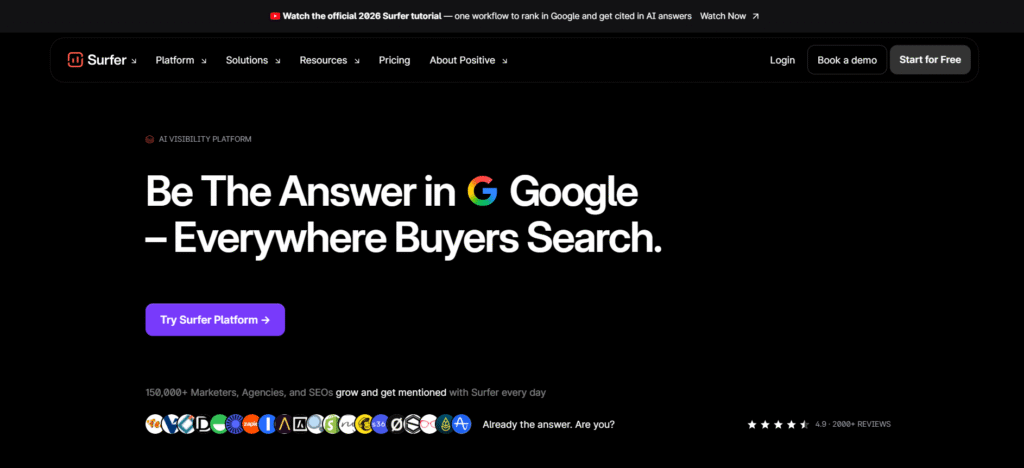
Surfer does not generate content, handle keyword research, or build content briefs. What it does, better than anything else at this price point, is tell you as you write or edit exactly what your draft needs to outrank the pages currently sitting in the top positions for your target keyword. The Content Editor updates in real time as you type, surfacing missing semantic terms, structural gaps, and word count targets pulled from actual top ranking competitors.
Features:
- Standard: create or optimize 360 documents, track AI visibility with 25 prompts refreshed weekly, plus integrations, brand knowledge, one click content optimization, team collaboration, a plagiarism checker, and rank drop detection
- Pro: everything in Standard, plus 50 prompts refreshed daily, more integrations, 5 brand workspaces, one click internal linking, content ideas, and a cannibalization report
- Peace of Mind: everything in Pro, plus unlimited documents, 100 prompts refreshed daily, unlimited workspaces, advanced SERP analysis, personalized onboarding, a dedicated success manager, and API access
Prices: Standard is $99/month billed yearly or $119/month billed monthly. Pro is $182/month billed yearly or $219/month billed monthly. Peace of Mind is $299/month billed yearly or $359/month billed monthly. The pricing page currently shows “Start for Free” buttons on every plan, so check Surfer’s site directly for current trial terms.
Reviews: G2 places Surfer at 4.8/5 across 545 reviews, the most reviewed tool in this comparison. Accuracy is the standout praise. Users report that following the Content Score recommendations measurably lifts rankings. Price comes up repeatedly as the main drawback, especially from freelancers and small teams.
What works well:
- Real time Content Score removes most of the guesswork from on page optimization
- Works inside Google Docs, so you can optimize where you are already writing
- SERP analysis explains why current top ranking pages are performing, not just what to copy
- AI visibility tracking adds a useful signal on top of traditional rank data
Where it falls short:
- Even at the yearly rate, this is one of the pricier tools on the list. Low volume publishers will struggle to justify the per article cost
- The SERP data has a learning curve and takes some interpretation
- Does not replace a keyword research or brief generation tool. Those stages sit entirely outside its scope
Honest verdict: If you already have a content production rhythm and want to stop guessing why your articles are not ranking, Surfer gives you the clearest answer available at this price point. Bring a draft, use the Content Score, and it tells you exactly what is missing.
3. Frase, Best for Building Content Briefs Faster Than Any Other Tool
Best for: Content strategists, freelancers, and small teams who lose too much time to research before they start writing.
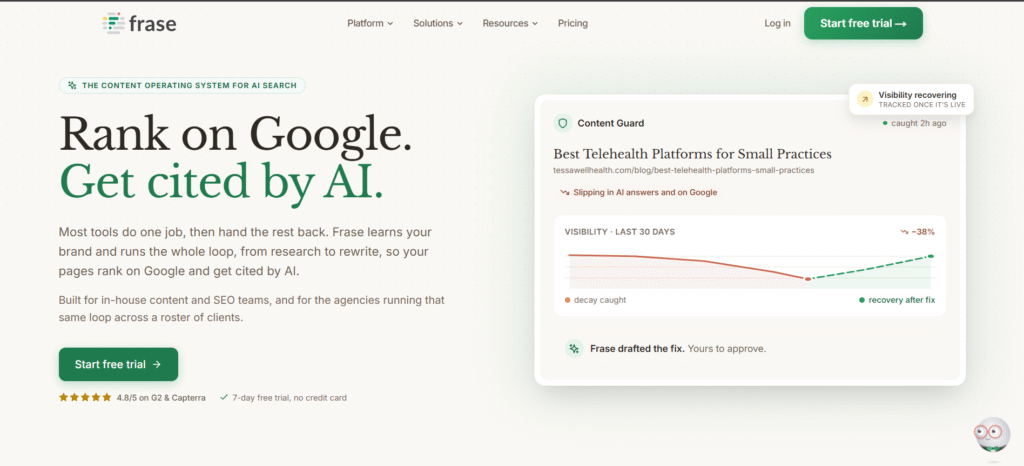
The most time consuming part of ranking content usually is not the writing. It is understanding what the top ranking pages already cover, what questions they miss, and how to structure an outline around real search intent. Frase compresses that into minutes. You give it a keyword, and it pulls the top ranking pages, maps what they cover, surfaces question gaps, then generates a structured brief with suggested headings.
Features:
- Starter: 1 seat and 1 site, 10 articles and 50 audit pages a month, publishing to WordPress, Webflow, Sanity, Wix, or Frase’s own CMS, plus SEO and GEO scores and AI visibility tracking on ChatGPT
- Professional (most popular): 3 seats and 5 sites, 40 articles and 250 audit pages a month, a content calendar, and internal linking suggestions
- Scale: 5 seats and up to 10 domains, 100 articles and 1,000 audit pages a month, and Content Guard, which watches 50 pages and adds Claude and Gemini to AI visibility tracking
- Enterprise: custom, with white label reports, SSO, and a dedicated account manager
Prices: Starter is $39/month billed yearly or $49/month month to month. Professional is $103/month billed yearly or $129/month month to month. Scale is $239/month billed yearly or $299/month month to month. Every plan includes a free 7 day trial with no credit card required.
Reviews: Rated 4.8/5 across 309 G2 reviews, Frase draws praise for SERP analysis quality, brief generation speed, and support responsiveness since its 2.0 relaunch. A cluttered interface is the most recurring complaint, and keyword volume data is noticeably weaker than what a dedicated keyword tool provides.
What works well:
- Brief generation that would take 2 to 3 hours manually takes about 10 minutes here
- Question research pulls from People Also Ask, Reddit, and Quora, capturing real audience language
- The built in document editor lets you write directly against the brief, no tab switching
- The 7 day trial with no card is enough to genuinely test fit before paying
Where it falls short:
- Keyword difficulty and volume data are weaker than dedicated keyword research tools
- AI drafted content needs significant editing. Treat it as a skeleton, not a finished post
- The interface takes longer to learn than it first appears
Honest verdict: Frase is the right pick when research is what is slowing you down, not writing. It does not try to be a full SEO suite, and that focus is exactly what makes it work so well for the brief stage.
4. NeuronWriter, Best Budget Option for Bloggers Who Want Real SEO Data
Best for: Solo bloggers, small business owners, and freelancers who want professional grade optimization without a professional grade budget.
NeuronWriter does much of what Surfer’s Content Editor does, analyzing top ranking competitors and giving real time NLP based optimization recommendations as you write, at a significantly lower price. The core value is straightforward: real on page SEO data without the premium price tag.
Features:
- Bronze: 2 projects, 25 content writer analyses, 5 AI monitored questions, and 15,000 AI credits
- Silver: 5 projects, 50 analyses, 7 monitored questions, and 30,000 credits
- Gold (most popular): 10 projects, 75 analyses, 10 monitored questions, 45,000 credits, a Content Designer, unlimited team members for content sharing, 75 plagiarism checks, and integrations with Google Search Console, WordPress, and Shopify
- Platinum and Diamond: scale those same limits further, up to 50 projects and 150 plagiarism checks on the top tier
Note: Google Search Console, WordPress, and Shopify integrations along with plagiarism checking only appear from the Gold plan upward. If those integrations are part of your workflow, Gold is your realistic entry point, not Bronze.
Prices: Bronze is $23/month month to month, roughly $19/month billed yearly. Silver is $45/month, roughly $37/month yearly. Gold is $69/month, roughly $57/month yearly. Platinum is $93/month, roughly $77/month yearly. Diamond is $117/month, roughly $97/month yearly.
Reviews: NeuronWriter sits at 4.4/5 across 31 G2 reviews. That is a notably thinner review sample than every other tool in this comparison, so treat the rating with a little more caution than Surfer’s or Scalenut’s. Reviewers most often mention a learning curve and AI draft quality that needs heavy editing before publishing.
What works well:
- Real optimization data at a price accessible to solo creators
- Internal link suggestions save the time a manual site audit would take
- The AI monitored questions feature tracks how content performs in AI search results
- Content scoring that is genuinely comparable to Surfer for standard on page work
Where it falls short:
- WordPress, Search Console, and plagiarism checking are not available on the two entry plans
- A noticeably thinner review base than competitors, worth keeping in mind
- AI writing output needs significant editing before anything goes live
Honest verdict: NeuronWriter vs Surfer comes down to budget and scale. If you are a solo blogger or small team and cannot justify $99 a month for Surfer, NeuronWriter gives you the core on page optimization data you actually need. Just be realistic about which plan tier your workflow requires.
5. RankIQ, Best for Finding Keywords You Can Actually Win

Best for: Bloggers and niche site owners who want to stop competing for keywords they have no real chance of ranking for.
Most keyword tools show you search volume and difficulty and leave you to guess whether your site can compete. RankIQ takes a different approach. It curates hand picked keyword libraries by niche, such as food, parenting, travel, and gardening, selecting low competition, high traffic potential terms that sites with weaker domain authority can realistically win. For a blogger who has been publishing without ranking results, this often fixes the actual problem: not the content quality, but the keyword strategy underneath it.
Features:
- Curated keyword libraries organized by industry, ranked on traffic potential and competitiveness
- A content grading system that shows how well a draft aligns with what is currently ranking
- Traffic estimates per post to help you prioritize what to write first
Prices: RankIQ does not appear to have its own standalone pricing page. The only official pricing surface currently visible is a co-branded bundle page with a separate tool called Aided, an AI content and social app suite. That page lists RankIQ’s standalone value at $99/month and currently offers RankIQ plus Aided’s $299/month Unlimited plan together for $49/month as a limited time deal. If you only want RankIQ without the Aided bundle, it is worth reaching out directly to confirm whether a standalone plan is available.
Reviews: Rated 4.8/5 on G2. Reviewers consistently praise how much time it saves on keyword research and how clearly it lays out what to cover and how long a post should be. The monthly report cap is the limitation cited most.
What works well:
- Curated keyword libraries remove the most time consuming part of keyword research for newer sites
- Content grading shows how well a draft aligns with what is currently ranking
- Traffic estimates per post help you prioritize what to write first
- A simple, focused interface that does one thing well
Where it falls short:
- No free trial. You commit before testing
- No clear standalone pricing page, which makes it harder to evaluate value upfront compared to every other tool here
- Keyword library depth varies by niche. Some categories have thinner coverage than others
- Less useful for established sites with higher domain authority that can already compete for broader terms
Honest verdict: RankIQ solves a specific problem really well. If your site is not ranking because you are targeting the wrong keywords, not because your writing is poor, this tool fixes the root cause faster than any other option on this list.
How to Choose Based on Where You Are Actually Stuck
Targeting the wrong keywords entirely: RankIQ’s curated low competition libraries skip the research phase that wastes most new bloggers’ time.
Research and briefs taking too long before you even start writing: Frase compresses that process. The 7 day no card trial makes it the easiest to test without commitment.
Writing content that does not rank despite covering the right topic: Surfer’s real time Content Score is the most actionable feedback available at this price point. Bring a draft, and it tells you what is structurally missing.
Need Surfer’s optimization quality but cannot justify the price: NeuronWriter delivers comparable on page analysis for significantly less. Just budget for the tier that includes the integrations you actually need.
Managing a full content team and need everything in one place: Scalenut is the most complete option, covering keyword clustering, briefs, drafting, and GEO tracking in a single workflow.
Frequently Asked Questions
Can AI SEO tools actually help content rank on Google in 2026?
Yes, with a qualifier. Tools that analyze search intent, identify semantic keyword gaps, and match content structure to what is currently ranking are genuinely effective at improving ranking probability. Tools that only speed up text generation without SEO intelligence built in do not move the needle on their own. They just produce faster output with the same strategic gaps underneath.
Is Scalenut better than Surfer?
They are built for different stages of the same process. Scalenut runs the full workflow from keyword research to a GEO optimized draft. Surfer is built for optimizing content you have already written. Many teams use both: Scalenut for planning and briefs, Surfer for final optimization before publishing.
NeuronWriter vs Surfer SEO: which should you pick?
If budget is the deciding factor, NeuronWriter gives you comparable on page content scoring at a fraction of Surfer’s price. If you need deeper SERP data, Google Docs integration, and a larger review track record backing the tool’s accuracy, Surfer is worth the extra cost. The gap narrows significantly at NeuronWriter’s Gold plan.
What is GEO and why does it matter in 2026?
GEO stands for Generative Engine Optimization. It means structuring content so it gets cited in AI generated search results from platforms like Perplexity, ChatGPT Search, and Google AI Overviews, not just ranked in traditional Google results. As these platforms take a growing share of informational search queries, content optimized only for traditional rankings is missing an increasingly important visibility channel.
Which of these tools offer free trials?
Scalenut and NeuronWriter both offer trials. Frase offers a 7 day trial with no credit card required. Surfer’s pricing page currently shows “Start for Free” options on all plans, so check current terms directly on their site. RankIQ has no free trial.
How long does it take to see results from AI SEO tools?
Most SEO results take 4 to 12 weeks regardless of which tools you use. What these tools change is the quality of what you are publishing going in: better intent matching, better structure, better semantic coverage. They do not make Google rank you faster. They make what you publish worth ranking.