
If you searched “Alaya AI” hoping for a straight answer on whether this is a data-labeling company, a cryptocurrency, or both, you’re not alone.
Most of what’s currently ranking doesn’t clear that up.
Alaya AI is a Web3 platform that pays contributors in blockchain tokens to label AI training data. It also has a governance token, AGT, that trades on several exchanges with real, sharp price swings.
Both are true at once.
What most existing coverage gets wrong isn’t a missing fact here or there. It’s that several ranking pages contradict each other, and sometimes contradict themselves, on basic details like price, supply, and what chain the project even runs on.
That’s the first thing worth knowing before anything else.
One Project, Two Tokens
Alaya AI runs a dual-token model.
ALA is the internal utility token. Requesters fund labeling projects with it, and contributors get paid in it for completing tasks.
AGT is the governance token. It’s listed on exchanges like KuCoin, LBank, and MEXC, and it’s what people actually mean when they ask about “Alaya AI’s price.”
These two tokens serve completely different purposes. Mixing them up, which a lot of articles do, leads to wrong conclusions about what you’re holding or earning.
Here’s a quick snapshot before we go deeper.
Alaya AI at a Glance
- Platform type: Decentralized AI data labeling and annotation
- AGT trades on: BNB Chain (platform infrastructure runs on Arbitrum, opBNB)
- Tokens: ALA (utility, task payments), AGT (governance, exchange-traded)
- Price (as of writing): approximately $0.0145, highly volatile
- Exchanges: KuCoin, LBank, BingX, MEXC, and 9 others
- Supply: 5,000,000,000 max/total; circulating supply not publicly reported
- Fully diluted valuation: approximately $72.5 million
- All-time high / low: $0.03632 (May 2025) / $0.00244 (Oct 2025)
- On-chain activity (per BNB Chain’s DappBay): no measurable transaction or user data recorded as of this writing
- TGE platform: Binance Wallet
- Security audit: CertiK, 89.86/100 (AA rated)
Now let’s look at what the platform actually does under the hood.
What the Platform Actually Does
Strip away the token layer, and Alaya AI is a decentralized AI data-annotation marketplace.
Businesses post labeling projects. A global contributor network completes them in small tasks. A verification layer checks quality before payment is released.
It stands out from traditional vendors like Scale AI in three ways:
- Blockchain-recorded task history, so who labeled what and when is traceable rather than sitting in a private database.
- Gamified contributor engagement, using streaks, leaderboards, and tiered task access to keep participation rates high.
- DAO governance, letting AGT holders vote on platform decisions instead of leaving everything to a core team.
Onboarding is low-friction. You only need an email to get started. No wallet is required until you’re ready to withdraw. A referral program and AGT staking are also available on the platform.
According to Alaya AI’s own documentation, platform infrastructure runs on Arbitrum and opBNB, which is separate from the BNB Chain deployment where AGT itself trades.
That distinction matters more than most summaries let on, as you’ll see in the next section.
What AGT Looks Like Right Now
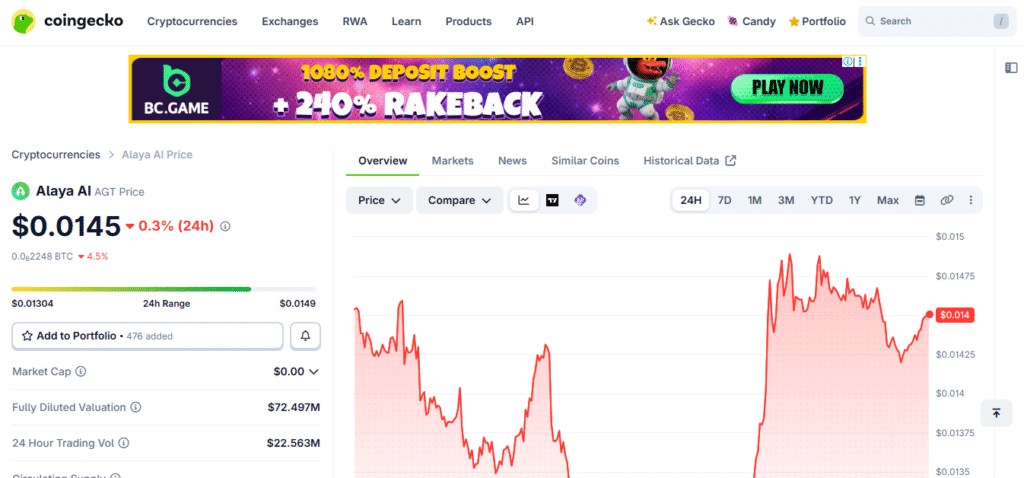
As of this writing, AGT trades around $0.0145, down 0.3% over 24 hours, per CoinGecko’s live tracker.
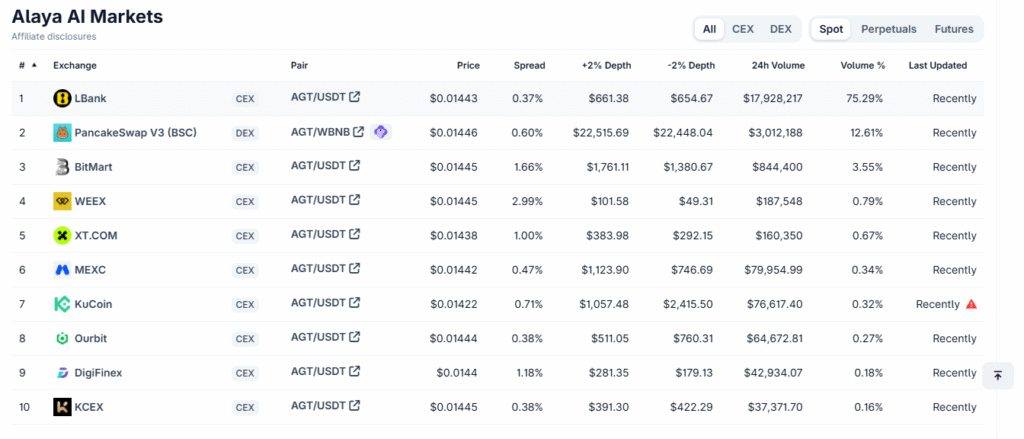
It’s listed across 12 markets, with LBank’s AGT/USDT pair leading daily volume at over $17.9 million in 24 hours.
Supply is capped at 5 billion. CertiK’s security score sits at 89.86 out of 100, earning an AA rating across code security, operational, and governance dimensions.
The price history tells a clear story about volatility: all-time high of $0.03632 set in May 2025, all-time low of $0.00244 in October 2025. That’s nearly a 15x swing between the two points.
Double-digit daily moves aren’t rare for this token. If the price looks different from what’s written here, that’s not an error in this article, it’s how AGT behaves.
Token unlock events also affect price periodically. CertiK’s pulse feed flagged an AGT unlock worth approximately $1.85 million in mid-July 2026, the kind of scheduled event that can move a small-cap token noticeably in either direction.
One more thing worth flagging: market cap isn’t calculable because circulating supply isn’t publicly reported anywhere. What trackers show instead is a fully diluted valuation of around $72.5 million, based on the full 5 billion token supply.
Neither task pay nor enterprise pricing is published by the platform. Treat any “$X per task” figure you see elsewhere as an old estimate, not an official rate.
This pricing transparency gap ties directly into a bigger problem across existing Alaya AI coverage.
Why So Much Existing Coverage Contradicts Itself
This is the part almost nobody researching Alaya AI gets told.
Several pages disagree with each other on facts that should be simple to verify.
One widely cited source states the ALA token runs on Polygon with a fixed 100 million supply. Alaya AI’s own documentation places platform infrastructure on Arbitrum and opBNB instead, with no Polygon deployment mentioned.
Another source quotes a specific AGT price from August 2024 as if it were current, off by more than a year from when it was actually accurate.
A third frames AGT with stock-market language, citing “analyst ratings” ranging from “hold” to “strong buy.” That framing doesn’t apply here. AGT is a governance token, not an equity. No formal analyst coverage exists for it in the way that language implies.
There’s also a gap between the growth numbers some articles repeat (over 400,000 registered users, more than 200,000 social followers, roughly 1,500 blockchain transactions daily) and what’s independently verifiable.
BNB Chain’s own dApp directory, DappBay, tracks Alaya AI’s on-chain activity on opBNB. As of this writing, it shows no measurable transaction or user data for the tracked period.
That doesn’t necessarily mean the platform has zero activity. A chunk of contributor work likely happens off-chain before settlement. But it does mean those specific growth figures can’t currently be verified through an independent, official source.
Treating them as confirmed fact would be a mistake.
If two sources disagree on something as basic as which blockchain a token runs on, that’s a clear signal to go straight to the project’s own documentation rather than trusting either summary.
With that context in place, the question of safety becomes a lot more specific.
Is Alaya AI Safe to Use or Trade?
“Safe” means different things depending on your role, and each role carries a different risk profile.
As a contributor: the main risk isn’t the platform disappearing. It’s that your earnings are denominated in a token whose dollar value moves fast. A task that pays a fixed amount of ALA can be worth noticeably less by the time you convert it.
As a requester: blockchain-recorded task history is a genuine advantage for compliance-sensitive teams, since you get an auditable trail of who labeled what. The tradeoff is a shorter, less established track record compared to vendors like Scale AI.
As a token holder: AGT carries standard small-cap risk. Thinner order books on some exchanges, real price volatility, and less regulatory oversight than traditional securities.
CertiK’s 89.86 AA-rated score is a genuine positive signal for contract-level security. But it says nothing about business activity, price direction, or whether the platform’s usage claims actually hold up.
That last point is exactly where the on-chain data gap above becomes relevant. A solid audit score doesn’t confirm the growth numbers some articles repeat without checking.
What would actually change your answer here: the platform’s day-to-day utility, or the token’s price chart? For most people asking about “Alaya AI,” it’s really the second one, even when the question is phrased as the first.
What About an Alaya AI Price Prediction?
No legitimate source can reliably forecast where a small-cap token like AGT will trade next month.
Any article that hands you a confident number is guessing, not forecasting.
What’s actually knowable is the set of factors that tend to move AGT’s price: new exchange listings, DAO governance decisions, verifiable platform growth, and broader crypto market sentiment. AGT has generally tracked wider market moves rather than trading on isolated project news.
If you’re weighing whether to buy or hold AGT, that’s a decision for your own research, ideally alongside a conversation with a financial advisor. It’s not something this article, or any other, should be telling you to do.
Common Mistakes People Make With Alaya AI
Confusing ALA and AGT.
They’re not interchangeable. Mixing them up leads to wrong assumptions about what you’re holding or earning.
Trusting stale price data.
Several existing articles quote AGT prices from mid-2024 while calling them current. Always check a live tracker like CoinGecko or the exchange you’re trading on directly.
Treating unsourced growth numbers as confirmed.
User counts and daily transaction figures circulating on some sites aren’t traceable to any official report or on-chain data. Check DappBay or the project’s own channels before repeating them.
Reading token coverage like stock coverage.
There’s no equity, no board, and no formal analyst rating system behind AGT. Stock-market language doesn’t map onto how a governance token actually works.
Assuming “audited” means “risk-free.”
A CertiK score reflects smart contract security, not price stability, project longevity, or the accuracy of the platform’s own marketing claims.
Who Alaya AI Actually Fits
AI startups and researchers needing labeled datasets without enterprise vendor overhead may find the cost structure attractive, provided they’re comfortable funding projects in crypto and doing their own diligence on the provider’s track record.
Contributors comfortable with crypto volatility who want flexible microtask income can get started quickly. Onboarding doesn’t require lengthy vetting or an existing crypto setup.
Compliance-focused teams may value the auditable, blockchain-recorded task history. That said, they should weigh it against the platform’s shorter operating history compared to established vendors.
Anyone uncomfortable holding volatile tokens, or anyone who isn’t willing to verify claims independently before acting on them, should treat any AGT exposure as a small, deliberate decision rather than something to fall into passively.
Where This Leaves You
Alaya AI is a real, functioning data-labeling platform with a live, actively traded governance token.
It’s not a vague concept, and it’s not obviously a scam.
But it answers two very different questions depending on why you’re here.
If you’re evaluating the platform, look at contributor onboarding and the auditable task-history model, and treat unverified growth stats with real skepticism.
If you’re evaluating AGT as a token, look at its volatility history and exchange listings, and don’t let anyone hand you a price target dressed up as research.
Either way, check the numbers against a live, official source before you act. This niche moves fast enough, and existing coverage contradicts itself often enough, that yesterday’s “current” figure can already be wrong.
FAQs
What is Alaya AI?
Alaya AI is a decentralized platform that pays contributors in blockchain tokens to label AI training data, combining blockchain-recorded task history with DAO governance through its AGT token.
What’s the difference between AGT and ALA?
ALA funds and pays for labeling tasks, while AGT is the governance token traded on exchanges like KuCoin and MEXC. Confusing the two is one of the most common mistakes people make when researching this project.
Is Alaya AI safe to use?
Its AGT token carries a CertiK security score of roughly 89.86 out of 100, reflecting solid contract security. Safety beyond that depends on your comfort with crypto payments and volatility, and on independently verifying any usage claims rather than taking them at face value.
Alaya AI vs. Scale AI, what’s different?
Alaya AI uses a decentralized contributor network instead of an in-house or vendor team, which generally lowers cost but comes with a shorter, less established track record.
How many users does Alaya AI actually have?
Not publicly confirmed through an independent source. Some sites cite figures like 400,000-plus users, but BNB Chain’s own DappBay directory shows no measurable on-chain transaction or user activity for the tracked period. Treat any specific user count as unverified until the project publishes sourced numbers.
Where can you buy Alaya AI (AGT)?
AGT is listed on centralized exchanges including KuCoin, LBank, BingX, and MEXC, with LBank currently carrying the highest trading volume for the AGT/USDT pair. AGT runs on BNB Smart Chain under contract address 0x5dBde81fcE337FF4bcaaEe4Ca3466C00aeCaE274. Cross-check this against BscScan or CoinGecko before trading, since token impersonation is common in crypto.
Does Alaya AI have a price prediction?
Not publicly confirmed. AGT is a small-cap, volatile token, and no reliable source can forecast its future price with confidence. Treat any specific price prediction you find elsewhere with skepticism.
Is there an Alaya AI airdrop?
Not publicly confirmed beyond the original token generation event, which was conducted through Binance Wallet’s launch platform. Any future airdrop announcements would come through Alaya AI’s official Twitter or Telegram channels.