
Every vendor selling an AI customer support tool right now will tell you the same things: 80% ticket deflection, instant setup, your agents freed up to focus on “complex work.” After spending time across pricing pages, user review threads, and real deployment benchmarks for this piece, one thing became clear: those numbers need a lot of context before they mean anything to your business.
The best AI tools for customer support in 2026 can realistically reach 60 to 75% autonomous resolution within 12 months on well-scoped query types, but only after months of knowledge base tuning. New deployments typically land at 30 to 50%.
If a tool is promising you 80% from day one, that is a deflection rate, not a resolution rate, and the difference matters more than most listicles bother to explain.
This article covers 10 picks across every tier, from completely free tools to mid-market platforms, with honest resolution benchmarks, real user voices, and a direct use-case guide so you can match the right tool to your actual situation.
What makes an AI customer support tool actually worth using in 2026
The single most important factor is not the feature list. It is whether the vendor reports resolution rate or deflection rate.
Deflection rate counts conversations that never reached a human agent, including customers who got a half-answer and gave up. Resolution rate counts tickets the AI fully closed with a satisfactory outcome. Most vendors quote deflection because the number is higher.
According to Lorikeet CX benchmarks (June 2026), realistic resolution rates are 30 to 50% for new deployments, 60 to 75% as workflows mature, and 70 to 85% for deeply integrated agents. Richpanel’s 2026 statistics confirm mature autonomous AI lands at 50 to 80% true end-to-end resolution on routine support.
One more thing that separates useful tools from well-marketed ones: knowledge base quality beats model quality every time. A Shopify App Store reviewer (April 2025) warned that an AI support tool could not answer “how much is shipping” because it had no access to current product data. The AI model is almost never the limiting factor. Your content is.
Before evaluating any tool below, ask two questions: Does it connect to your actual product data? And does the vendor report true resolution or just deflection?
The quick decision guide: match the tool to your situation
You run a Shopify store with under 500 tickets per month: Start with Gorgias. It connects directly to your order data and handles WISMO queries without human intervention. Tidio is a solid lower-cost alternative.
You run a SaaS product and need strong conversational AI: Intercom’s Fin AI Agent is built for this. Per-resolution pricing keeps costs tied to outcomes, though you should model your volume before committing.
You manage a growing support team of 5 to 20 agents: Freshdesk with Freddy AI starts at $19 per agent per month versus Zendesk’s $55, and the free plan is a legitimate starting point.
You need enterprise-grade routing, SLA management, and scale: Zendesk AI is the default choice, but budget for the AI Copilot as a paid add-on. Real-world resolution rates start lower than marketed.
You want to start for free and test before buying anything: Tidio’s free tier (50 conversations per month with Lyro AI) or Chatbase’s free plan (50 message credits) are the lowest-friction entry points.
At a glance: all 10 tools compared
| Tool | Best For | Starting Price | Free Plan | AI Type | G2 Rating |
|---|---|---|---|---|---|
| Freshdesk (Freddy AI) | Growing teams | $19/agent/mo | Yes | Copilot + automation | 4.4 |
| Zendesk AI | Large teams, complex routing | $55/agent/mo | Free trial | Copilot + AI agents | 4.3 |
| Intercom (Fin AI Agent) | SaaS teams | $0.99/outcome | Free trial | True AI agent | 4.5 |
| Tidio (Lyro AI) | SMBs, ecommerce under 500 tickets | $24.17/mo | Yes (50 convos) | Conversational AI | 4.6 |
| Zoho Desk (Zia AI) | Zoho ecosystem teams | $7/user/mo | Yes (3 agents) | Agent assist | 4.4 |
| Gorgias | Shopify ecommerce | $40/mo | Free trial | Ecommerce AI agent | 4.6 |
| Help Scout | Small teams, human-first | $30/user/mo | Free trial | AI Drafts + AI Answers | 4.4 |
| HubSpot Service Hub | HubSpot CRM users | $7/seat/mo | Yes (2 users) | Breeze AI agent | 4.4 |
| Chatbase | Solo operators, testing | $0 | Yes (50 credits) | Standalone AI chatbot | 4.8 |
| Tawk.to | Free live chat + basic AI bot | $0 | Yes (forever) | Basic AI chatbot + human chat | 4.6 |
Best AI tools for customer support in 2026
1. Freshdesk (Freddy AI)
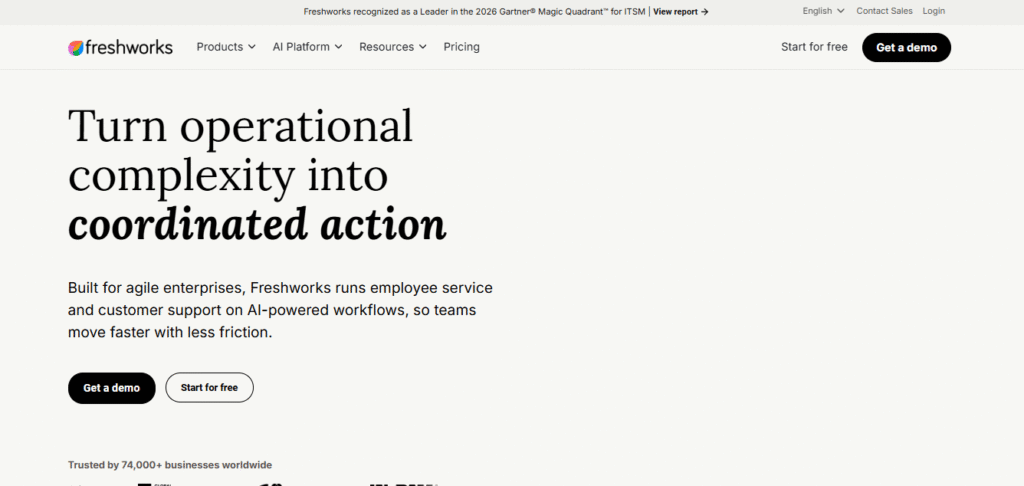
Verdict: Best all-rounder for growing support teams that want AI without enterprise pricing. Freshdesk starts at $19 per agent per month, and is trusted by 74,000+ businesses worldwide.
Best for: Teams of 3 to 30 agents moving off shared inboxes who need a full helpdesk and AI in the same platform.
Key AI features:
- Freddy Copilot surfaces reply suggestions and relevant knowledge base articles to agents in real time, cutting handle time on tickets that still need a human
- Freddy Self Service is the customer-facing autonomous bot that handles tier-1 queries without agent involvement, a separate capability from Copilot and the one that actually drives your deflection numbers
- Automatic ticket categorization and sentiment tagging routes tickets to the right queue before any agent touches them
Pricing: Freshdesk standalone Growth plan at $19 per agent per month (billed annually). Freshdesk Omni, which adds omnichannel support across chat, social, and phone, starts at $29 per agent per month (billed annually) or $35 per agent per month (billed monthly). Pro at $79 per agent per month (annual). Enterprise at $119 per agent per month (annual). All plans include Freddy AI Agent with the first 500 sessions included. Additional AI Agent sessions cost $49 per 100 sessions. Freddy AI Copilot is a paid add-on at $29 per agent per month on Pro and Enterprise plans only. Free trial available on all plans.
Honest limitation: Real-world Freddy AI deployments land at 35 to 50% resolution rate in the first few months, well below the 80% Freshworks markets on its own pages. Budget 3 to 6 months of knowledge base tuning before those numbers move.
G2 rating: 4.4/5 (3746 reviews)
2. Zendesk AI
Verdict: Best for large teams with complex routing, SLA management, and omnichannel support needs.
Best for: Teams of 20+ agents running support across email, chat, voice, and social channels who need enterprise-grade configuration and reporting.
Key AI features:
- Intelligent triage reads ticket content and routes to the right queue and agent based on intent, sentiment, and customer tier before a human ever looks at it
- AI Copilot (paid add-on) gives agents real-time reply suggestions, knowledge base surfacing, and conversation summaries across all channels including voice
- Omnichannel AI coverage across email, live chat, voice, and social in a single unified workspace, the primary reason large teams choose Zendesk over Freshdesk at scale
Pricing: Support Team at $19 per agent per month (no AI agents included). Suite Team at $55 per agent per month (includes AI agents and knowledge base). AI Copilot add-on at $50 per agent per month on top of suite pricing. All prices billed annually. Free trial available.
Honest limitation: Zendesk marketed 50 to 80% resolution rates at its AI relaunch in late 2025. Fresh deployments realistically land around 20% resolution in the first quarter. The AI Copilot is an add-on at $50 per agent per month on top of suite pricing, and costs can escalate sharply as team size grows. Model your full bill before scaling.
G2 rating: 4.3/5 (7009 reviews)
3. Intercom (Fin AI Agent)
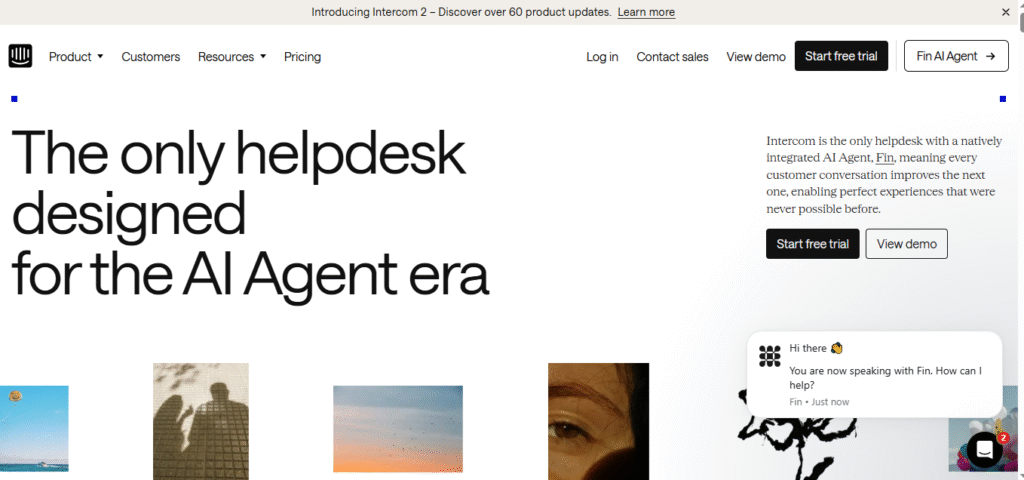
Verdict: Best conversational AI for SaaS and product-led teams who want per-outcome pricing tied to real results.
Best for: SaaS companies with well-documented help centers handling a high volume of repetitive product questions.
Key AI features:
- Fin AI Agent handles multi-turn conversations, maintains context across a full session, and escalates to a human with complete conversation history when it cannot resolve, with no dead-end responses that leave customers stranded
- Works on top of your existing helpdesk including Salesforce, HubSpot, and others at the per-outcome rate only, with no Intercom seat required, meaning you do not need to migrate your support stack to use it
- Fin’s handoff logic sends full conversation context to the human agent on escalation, so the customer never has to repeat themselves
Pricing: Fin AI Agent at $0.99 per outcome with a 50-outcome minimum per month. If using with the Intercom helpdesk, add $19 per helpdesk seat per month. Copilot agent assist add-on at $35 per user per month. Free trial available. Note: Intercom recently launched Intercom 2 with over 60 product updates as of July 2026. Verify the current feature set at intercom.com before finalizing your evaluation.
Honest limitation: The 50-outcome monthly minimum means a floor of $49.50 in Fin fees before your first ticket is handled. At 5,000 resolutions per month, Fin fees alone reach $4,950 on top of seat costs. Run the math against your ticket volume before committing.
G2 rating: 4.5/5 (3783 reviews)
4. Tidio (Lyro AI)
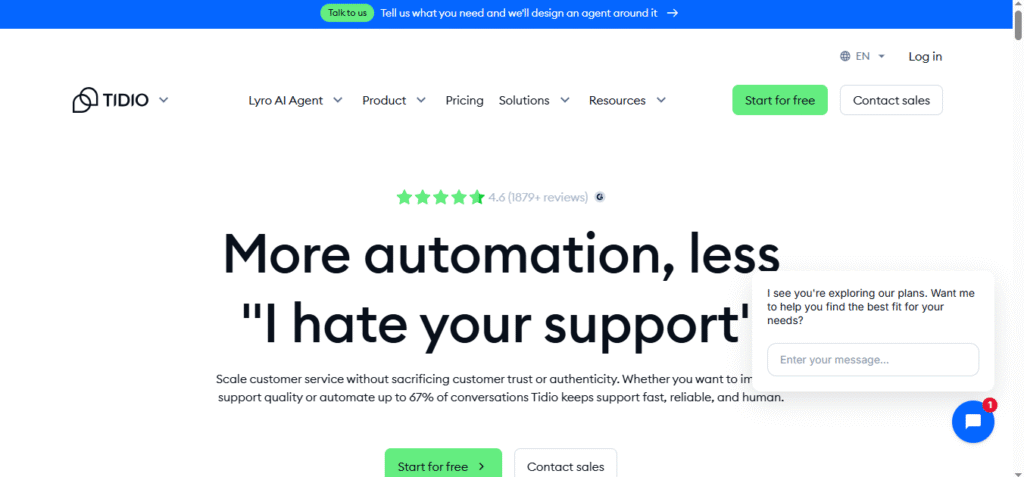
Verdict: Best AI customer support tool for small businesses and ecommerce stores under 500 tickets per month.
Best for: Small ecommerce stores, local service businesses, and early-stage SaaS teams testing AI support before committing to a full platform.
Key AI features:
- Lyro AI handles multi-turn conversations, maintains context within a session, and hands off to a human agent cleanly when a query falls outside its knowledge scope
- Trains on your uploaded knowledge base content and responds to customer queries autonomously without requiring developer setup
- Built-in live chat and AI operate from a single interface, so smaller teams are not managing two separate tools for the same function
Pricing: Free plan includes 50 conversations per month with Lyro AI active. Starter plan at $24.17 per month. Tidio claims to automate up to 67% of conversations.
Honest limitation: Mobile notifications are unreliable at the starter tier, and the AI assistance becomes less consistent on queries that fall outside your uploaded content. Tidio does not scale well beyond 1,000 tickets per month. At that volume, Freshdesk or Intercom is a better fit.
G2 rating: 4.6/5 (1,879+ reviews)
5. Zoho Desk (Zia AI)
Verdict: Best budget helpdesk with AI for teams already running inside the Zoho ecosystem.
Best for: Teams already using Zoho CRM or Zoho One who want AI-assisted support without adding a second vendor to their stack.
Key AI features:
- Zia on the Enterprise plan handles agent reply suggestions, customer sentiment tagging on incoming tickets, and auto-routing based on ticket content and urgency
- Anomaly detection flags unusual spikes in ticket volume automatically, useful for catching product incidents before they surface in escalations
- Built-in LLM is included across all paid tiers for basic generative reply assistance, though autonomous customer-facing resolution requires the Enterprise plan
Pricing: Express plan at $7 per user per month. Standard at $14 per user per month. Professional at $23 per user per month. Enterprise at $40 per user per month. All prices billed annually. Full Zia AI including Answer Bot, sentiment analysis, and anomaly detection requires the Enterprise plan. No per-resolution fee at any tier.
Honest limitation: Zoho publishes no resolution rate data for Zia, making it impossible to benchmark against other tools before you buy. Zia only functions inside the Zoho ecosystem, so switching helpdesks means leaving it behind entirely.
G2 rating: 4.4/5 (7444 reviews)
6. Gorgias
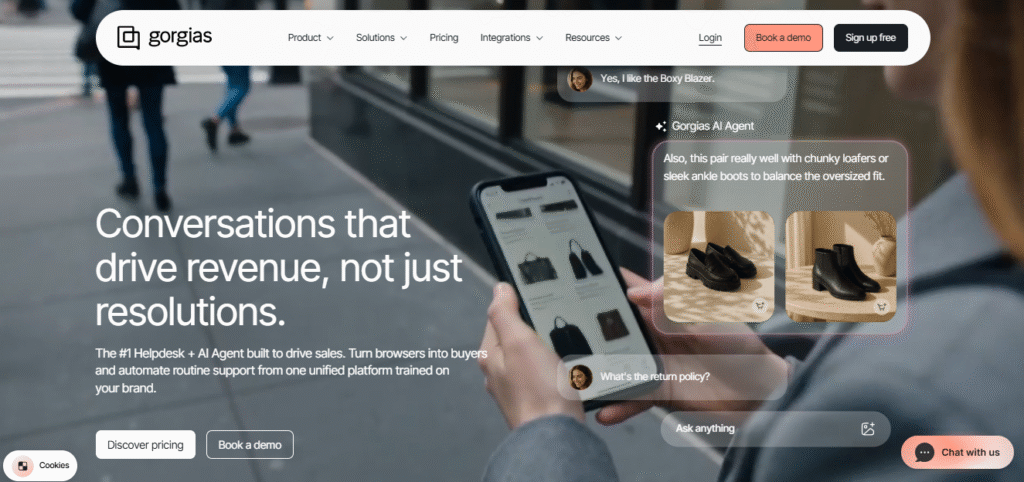
Verdict: Best AI customer support tool for Shopify ecommerce, with direct order data access no generic AI chatbot can replicate.
Best for: Shopify stores handling more than 100 support tickets per month, especially WISMO queries, return requests, and discount code questions.
Key AI features:
- AI Agent connects directly to live Shopify order data to resolve WISMO queries, process returns, and answer shipping questions using real order status, not static FAQ answers
- Automated responses to Instagram and Facebook comments and DMs using the same AI layer, useful for ecommerce brands managing community alongside support tickets
- Revenue statistics per ticket show agents which conversations are attached to high-value orders, letting them prioritize human attention where it matters most commercially
Pricing: Starter at $40 per month (50 tickets: $10 helpdesk + $30 AI Agent add-on). Basic at $90 per month (300 tickets: $60 helpdesk + $30 AI Agent). Per-ticket overage at $0.40 per ticket past your plan limit. AI Agent interactions beyond included volume at $1.50 per interaction. Monthly billing, cancel anytime. Free trial available.
Honest limitation: The layered pricing model creates unpredictable bills during high-volume periods. A store running 1,200 tickets in one Black Friday week on the Basic plan pays $0.40 per overage ticket on top of the $90 base and $30 AI Agent fee. Model that cost before peak season.
G2 rating: 4.6/5 (547 reviews)
7. Help Scout
Verdict: Best for small teams where support quality and tone are a brand differentiator, not just a cost center.
Best for: Teams of 2 to 10 agents in B2B SaaS, professional services, or any context where support interactions carry relationship weight.
Key AI features:
- AI Drafts generates a complete reply suggestion based on ticket content and your team’s previous replies, which agents edit and send, speeding response time without removing human judgment
- AI Summarize condenses long multi-message threads into a short summary for agents picking up a conversation mid-way, cutting context-reading time before replying
- AI Answers add-on resolves customer queries autonomously at $0.75 per resolution, the lowest per-resolution price among all tools in this list and cheaper than Fin AI Agent at $0.99
Pricing: Standard at $30 per user per month. Plus at $54 per user per month (includes unlimited AI Drafts and advanced workflows). Pro at $90 per user per month. AI Answers add-on at $0.75 per resolution with a 3-month free trial. Free trial available on Standard and Plus plans.
Honest limitation: Help Scout is built to assist agents, not replace them at scale. If you are handling 500+ tickets per month and want the AI to close most of them without agent involvement, Freshdesk or Intercom will serve that need better.
G2 rating: 4.4/5 (435 reviews)
8. HubSpot Service Hub (Breeze AI)
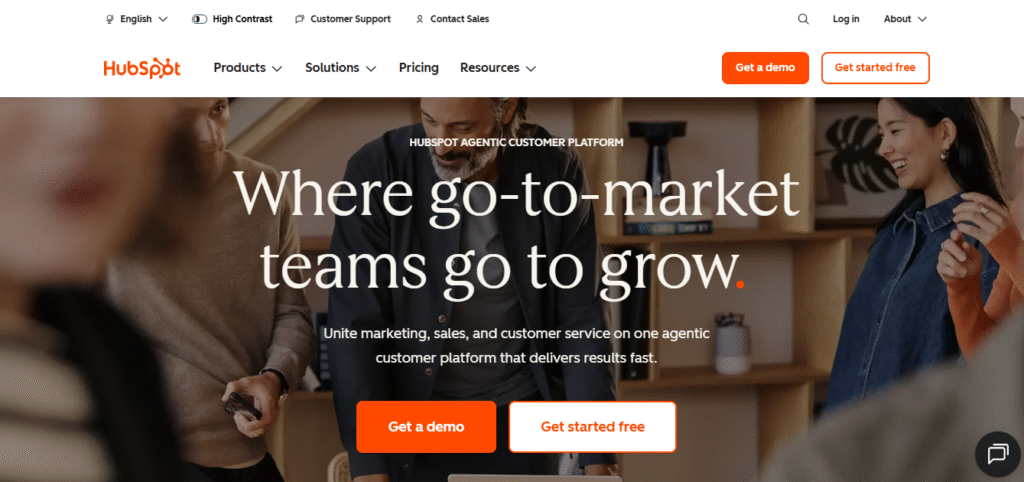
Verdict: Best for teams already running HubSpot CRM who want support, sales, and marketing data unified in one platform.
Best for: B2B SaaS or services companies using HubSpot across multiple functions who want a single platform rather than a separate support vendor.
Key AI features:
- Breeze AI Agent on the Enterprise tier resolves customer queries autonomously using your knowledge base and connected CRM data. HubSpot reports Enterprise users saw a 48% reduction in ticket resolution time.
- Every support ticket automatically maps to the customer’s full CRM record, giving both AI and human agents complete context including contract tier, renewal date, and previous support history on the first interaction
- Autonomous resolution requires the Enterprise plan. Professional tier includes AI-assisted routing and reply suggestions but does not close tickets without agent involvement
Pricing: Free plan available for up to 2 users. Starter currently at $7 per seat per month (billed annually) or $10 per seat per month (billed monthly), promotional rate against the standard $20 per seat price. Professional at $90 per seat per month (billed annually). Enterprise at $150 per seat per month with a 10-seat minimum. Mandatory one-time onboarding fees: $1,500 for Professional, $3,500 for Enterprise.
Honest limitation: A 10-agent team on Professional at $90 per seat looks like $900 per month. Once you add mandatory onboarding fees, a realistic first-year total lands closer to $18,000. If you are not already in the HubSpot ecosystem, Freshdesk or Intercom deliver comparable AI at a lower total cost.
G2 rating: 4.4/5 (2887 reviews)
9. Chatbase
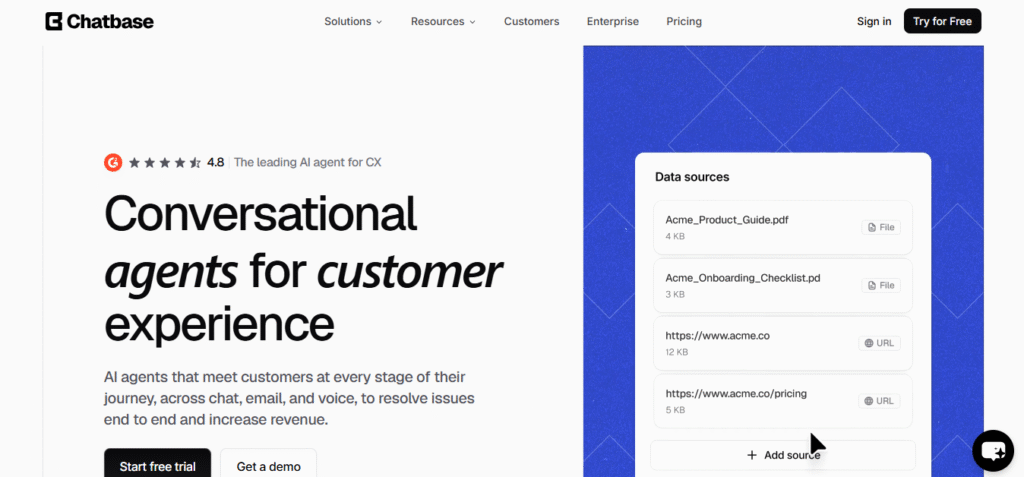
Verdict: Best free-to-test standalone AI chatbot for solo operators and micro-businesses not yet ready for a full helpdesk.
Best for: Solo operators, micro-businesses, and founders who want to test AI customer support before spending anything.
Key AI features:
- Builds an AI chatbot trained on your uploaded documents or connected website URLs in under an hour with no developer setup required
- Supports multilingual responses out of the box, useful for U.S. businesses with Spanish-speaking customer bases who want AI coverage without a paid platform
- Conversation logs show exactly what customers are asking and where the bot fails, giving you a low-cost way to identify your highest-volume query types before investing in a full helpdesk
Pricing: Free plan at $0 per month (50 message credits, 1 member). AI agents on the free plan are deleted after 14 days of inactivity, so if you build a bot and do not log in for two weeks, you start from scratch. Hobby plan at $40 per month (500 message credits). Standard at $150 per month adds helpdesk and voice features.
Honest limitation: Chatbase has no helpdesk, no ticketing system, and no escalation path. The Hobby plan’s 500 message credit cap runs out fast if your average support thread runs more than 2 to 3 exchanges. For any business handling more than 100 support contacts per month, this is a starting point, not a long-term solution.
G2 rating: 4.8/5 (24 reviews)
10. Tawk.to
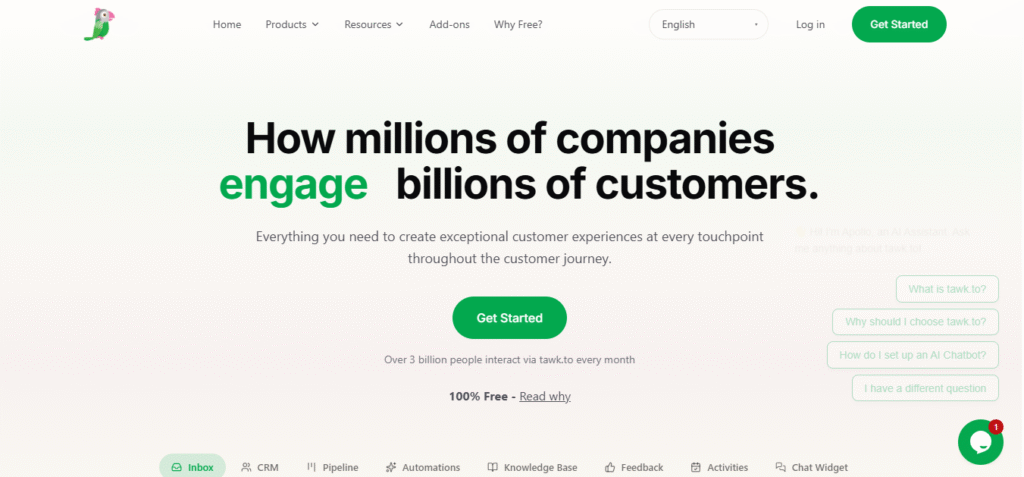
Verdict: Best completely free live chat platform with a built-in AI chatbot, making it the only tool in this list that costs nothing and includes both human chat and automated AI responses.
Best for: Small businesses and solo operators who need free 24/7 customer coverage across live chat and basic AI automation without any monthly cost.
Key AI features:
- Apollo AI Bot responds to customer inquiries 24/7 using your organization’s information, providing instant and consistent replies across channels without a human agent present
- AI Assist handles lead capture and basic customer questions autonomously, going beyond simple canned responses
- Unlimited human agent seats remain free alongside the AI layer, so you can run both staffed chat and AI automation from the same platform at no cost.
Pricing: Free forever for core live chat and AI Assist. Unlimited agents. Over 3 billion people interact via tawk.to every month. Add-on features available at extra cost.
Honest limitation: Apollo AI Bot is only as capable as the information you feed it. It is not a reasoning AI agent in the same class as Fin AI Agent or Lyro AI. Tawk.to has no native helpdesk or ticketing system, so complex queries, escalation tracking, and SLA management are not possible within the platform. It works as a first-response layer, not a complete support solution.
G2 rating: 4.6/5 (202 reviews)
What you should actually expect from AI customer support
Most vendors will not tell you this before the sale. Based on Lorikeet CX benchmarks (June 2026) and Richpanel’s 2026 statistics, here is what real deployments actually look like:
- Months 1 to 3: 30 to 50% resolution rate. Your knowledge base gaps are the bottleneck, not the AI.
- Months 6 to 12: 60 to 75% once you fill content gaps and tune escalation logic.
- 12+ months (mature deployment): 70 to 85% for tightly scoped, high-repetition query types.
One distinction that matters more than the overall number: a 70% resolution rate on WISMO queries is achievable for a Shopify store using Gorgias within 60 days. A 70% resolution rate on complex billing disputes is a 12-month project. Scope your expectations to your query types, not just your ticket volume.
Gartner predicts agentic AI will autonomously resolve 80% of common service issues by 2029, cutting operational costs by 30%. That outcome only materializes if you treat knowledge base cleanup as part of the launch process, not an afterthought.technical troubleshooting is a 12-month project at minimum. Scope your expectations to your query types, not just your overall ticket volume.
The most common mistakes when buying an AI customer support tool
1. Choosing on vendor claims instead of a bake-off. Zendesk marketed 50 to 80% resolution at launch. Freshworks claims 80% on its own pages. Neither figure reflects what new deployments actually see. Request a 30-day pilot on your actual ticket data before you sign anything.
2. Skipping knowledge base cleanup before launch. The AI resolves from your content. Outdated pricing in a help article, a policy change that was never updated, a product page that does not mention a key feature: all of these become sources of wrong answers that erode customer trust faster than no AI at all.
3. Not having a human-in-the-loop fallback. Agentic AI in 2026 is genuinely capable. It is not infallible. Every deployment needs a clear escalation path that hands off with context, not just a dead-end message that drops the customer.
4. Measuring deflection instead of resolution. Your AI dashboard will show you a deflection rate because that number looks good. Build a separate tracking workflow that captures whether the deflected ticket actually resolved, using CSAT follow-ups or re-open rates as proxies.
5. Picking an enterprise tool when you are an SMB. Zendesk and Intercom are excellent platforms. They are also designed for teams with a dedicated implementation resource and a 2 to 3 month setup timeline. If you are a 5-person team, Tidio or Freshdesk’s free plan will get you to 50% resolution faster with less configuration overhead.
The bottom line
Choosing the best AI tools for customer support comes down to one question: which tool matches your query type, your team size, and your budget. If you are running a Shopify store, start with Gorgias. If you are building SaaS support infrastructure, Fin AI Agent gives you the cleanest per-outcome pricing. If you need a full-featured helpdesk with AI at a price growing teams can afford, Freshdesk is the default pick. And if you are not ready to spend anything yet, Tidio’s free tier is the most honest starting point in the category.
The tools on this list can realistically reach 60 to 75% autonomous resolution within 12 months on well-scoped query types. But that number only materializes with the right content behind them. Sort your knowledge base before your first ticket touches the AI. That single step will do more for your resolution rate than any feature upgrade.
For more on how to evaluate AI tools across business functions, explore the AI tools directory at TheDiscoverAI.
Frequently asked questions
What is the best free AI customer support tool in 2026?
Tidio and Chatbase offer the most usable free tiers for small businesses. Tidio includes 50 conversations per month with Lyro AI active. Chatbase provides 50 message credits but deletes AI agents after 14 days of inactivity on the free plan. Freshdesk has a free helpdesk plan but Freddy AI Copilot requires a paid tier. Tawk.to is free forever but runs on human agents, not autonomous AI.
What is the difference between AI deflection rate and resolution rate?
Deflection rate measures how many conversations never escalated to a human agent, including customers who gave up without a real answer. Resolution rate measures tickets the AI closed with a confirmed satisfactory outcome. According to Lorikeet CX benchmarks (June 2026), mature AI support tools achieve 60 to 75% true resolution for well-scoped query types. Most vendors quote deflection because the number is always higher.
What AI customer support resolution rate should I realistically expect?
New deployments typically achieve 30 to 50% in the first 1 to 3 months. After 6 to 12 months of knowledge base tuning, 60 to 75% is achievable for routine support types, according to Lorikeet CX and Richpanel benchmarks from June 2026. Any vendor claiming 80%+ from day one is quoting deflection, not resolution.
Which AI tool is best for Shopify ecommerce customer support?
Gorgias is the clear pick for Shopify stores. It connects directly to your order data and handles WISMO queries, returns, and shipping questions autonomously using live order information. Tidio works well as a lower-cost alternative for stores under 500 tickets per month. Both integrate natively with Shopify.
Is Intercom or Zendesk better for AI customer support in 2026?
For SaaS teams with well-documented help centers, Fin AI Agent delivers better out-of-the-box conversational resolution. For large teams with complex routing, SLA management, and multi-channel operations, Zendesk is stronger. The critical pricing difference: Zendesk charges per seat, Intercom charges $0.99 per Fin AI Agent resolution, which becomes significant at high ticket volumes.
Can AI customer support tools replace human agents?
Not fully, and that should not be the goal. The realistic target for most teams is 60 to 80% autonomous resolution on routine tier-1 queries, with human agents handling escalations, complex issues, and high-empathy situations. Gartner predicts that by 2029, agentic AI will autonomously resolve 80% of common service issues, but the remaining cases will always require human judgment.
What features should I look for in an AI customer support tool?
When evaluating the best AI tools for customer support, focus on four things: native integration with your existing helpdesk and CRM; knowledge base connectivity so it pulls from your actual product data; clean human handoff logic that escalates with full context rather than dropping the conversation; and resolution tracking that reports true resolution, not just deflection. Sentiment analysis, multilingual support, and AI copilot for agents add value but should not drive the decision if the core four are missing.