

You searched “crypings review” and got a wall of confident answers. One site calls it a crypto analytics hub. Another calls it a wallet. A third calls it a trading-signals platform. I opened crypings.com myself to see which one was telling the truth, and the answer is none of them.
Crypings.com is a free general-interest blog covering finance, health, real estate, law, lifestyle, tech, and travel, published under the name “Cry Pings.” It isn’t a crypto exchange, wallet, analytics dashboard, or signals service, whatever the search results tell you. So where did all those other descriptions come from, and should you trust any of them?
The one-sentence answer, before the full story
Crypings.com is a general-topic content blog with seven categories (Finance, Health, Real Estate, Law, Lifestyle, Tech, Travel), no login, no crypto tools, and no publicly identified owner. It publishes occasional crypto-adjacent posts, but it functions as a lifestyle and finance blog, not a crypto platform of any kind.
What I actually found when I opened Crypings.com
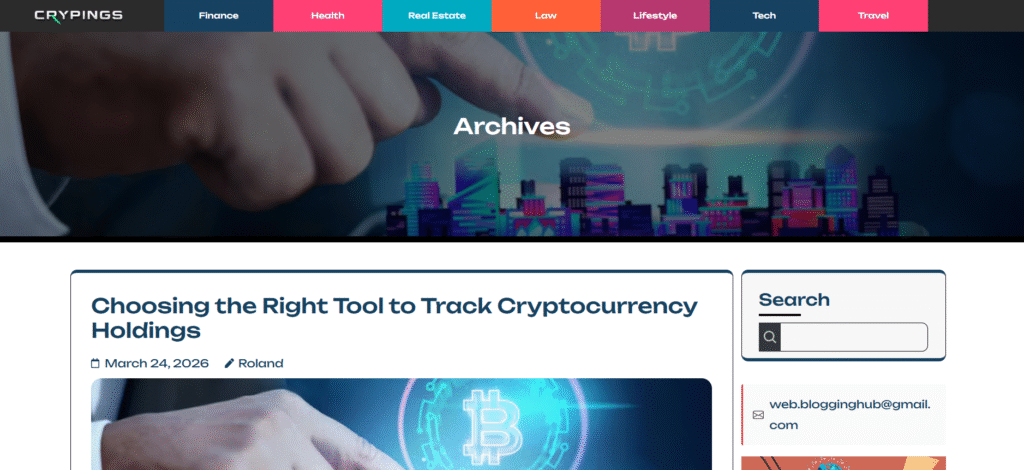
I visited the live site directly instead of trusting a secondhand description, and the gap between the marketing and the reality is the whole story.
The homepage greets you with an “Archives” banner over a stock crypto-city graphic, then a nav bar with seven tabs: Finance, Health, Real Estate, Law, Lifestyle, Tech, Travel. Nothing about wallets, dashboards, or trading. As of July 2026, the most recent posts included “Choosing the Right Tool to Track Cryptocurrency Holdings,” “How Financial Support Works During Legal Cases,” “What to Know About Living in University-Area Housing,” a piece on family bonding activities, and one on spotting a toxic relationship. The post archive stretches back to at least August 2025.
Every article I opened carried the same byline, “Roland.” The footer lists one contact point, a Gmail address, and no registered company name. So crypto sits here as one topic among seven, not a specialty. That alone should make you pause before trusting a review that describes Crypings.com as a dedicated crypto platform.
What the site says about itself, in its own words
I also read the site’s own About page rather than relying on what other blogs claim it says, and it settles the question directly. Crypings.com describes itself as a “trusted destination for practical wisdom” spanning digital marketing, education, business and finance, technology, lifestyle, travel, and general topics. Crypto isn’t mentioned once.
That’s a first-party admission that lines up with what I saw on the homepage and contradicts nearly every third-party “review” ranking for this keyword. One odd detail worth flagging: the About page links its own brand name out to a completely different domain, quikconsole.com, on two separate occasions, the kind of mismatch that shows up when a page has been assembled quickly rather than written with care.
So if the site itself doesn’t claim to be a crypto platform, why does half the internet insist it is?
I read six of its posts across six categories. Here’s what that told me

I opened one article from each of Crypings.com’s six busiest categories, and the same production pattern showed up in every one of them:
- Crypto tracking tools post: A generic listicle with no sign of any tool actually being tested, ending in an affiliate-style link to a third-party tracker site.
- Autoimmune diet guide: Closes with unnamed, undated “success stories,” a woman with rheumatoid arthritis, a man with multiple sclerosis, with no source or citation behind either.
- Legal-funding explainer: Reads as neutral education until it links twice to one specific lawsuit-funding company.
- Family-bonding listicle: Generic advice with no site-specific detail, plus the inconsistent bold and italic formatting typical of lightly edited AI output.
- Full-stack-hiring piece: Its featured image is a screenshot pulled straight out of Google Docs, and it links out twice to developer-staffing agencies.
- University housing guide: Drops in a UK man-with-a-van moving service and a Tokyo apartment listing in Japanese, neither of which has anything to do with US student housing.
All six share the same AI-generated hero image and the same byline, which links to an author page under a different name. None of it reads as tested or lived through. It reads as one production line built to carry a monetized link into every category.
The honest ratings based on what I actually found
| Category | Rating | What the evidence shows |
| Topic relevance | 2/5 | Crypto is one post among seven unrelated categories, not a specialty |
| Content originality | 2/5 | Same hero image and byline mismatch repeated across every category checked |
| Source transparency | 1/5 | Unnamed, uncited testimonials and unrelated affiliate links in place of real citations |
| Ownership transparency | 1/5 | No named owner, no company registration, only a general contact email |
| Trustworthiness for crypto decisions | 1/5 | No verifiable crypto features exist to evaluate in the first place |
Five reviews, five imaginary websites
Pull up the top-ranking “Crypings.com reviews” side by side and you get five different products, none of which match what’s actually on the site.
| What the review claims Crypings.com is | What I actually found on the site |
| A crypto analytics hub tracking 500+ coins with RSI and moving averages | No price charts, no indicators, no analytics of any kind |
| A crypto wallet and exchange with KYC and cold storage | No wallet, no trading, no account creation, no KYC |
| A crypto education hub with browser-based calculators | No calculators or interactive tools anywhere on the site |
| A trading-signals service with entry price and stop-loss alerts | No signals, no alerts, no trading features |
| A free multi-category content blog (closest to the truth) | Correct, though usually dressed up as “the best platform” |
A reviewer who genuinely opened this site couldn’t land on “KYC-verified wallet.” The most rigorous third-party breakdown I came across, a WHOIS and traffic analysis, backs this up. It found that every “review” in this cluster reads like it came from the same handful of SEO operations, several sharing near-identical structure and even an identical FAQ page across two different domains, and that a few of them describe features, like portfolio tracking and two-factor authentication, that simply are not on the site.
That’s not a difference of interpretation. That’s a specific, checkable claim that fails the moment you visit the page.
Does Crypings.com have Trustpilot or Reddit reviews?
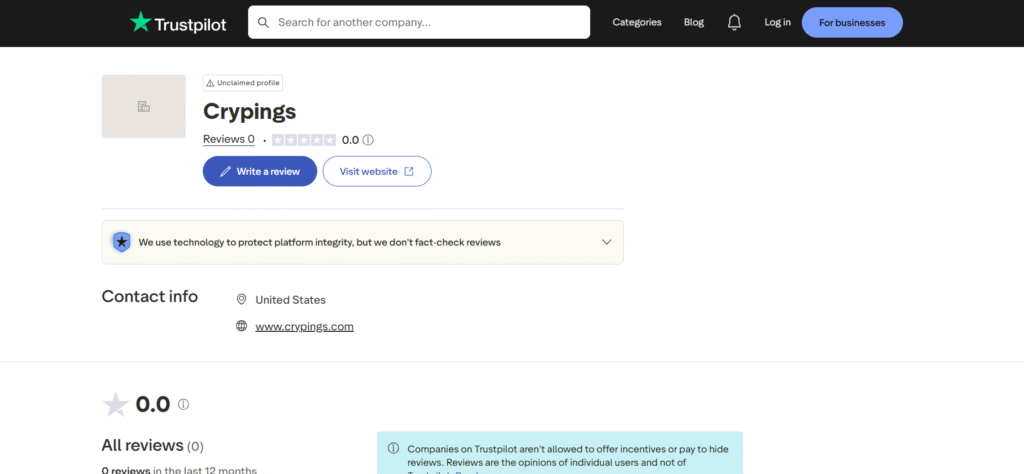
Short answer: no, and I looked. There’s no Trustpilot business profile for crypings.com, no meaningful thread on Reddit, and no mention on crypto-focused scam-watch communities either praising or warning about it.
That absence has a mundane explanation rather than a sinister one. Trustpilot reviews get generated by friction: a payment that didn’t process, a support ticket that went nowhere, an account that got locked. Crypings.com has no payments, no accounts, and no support tickets to complain about, so it never produces the kind of consumer experience that ends up on a review platform. A separate SEO-agency analysis makes this same point directly, arguing that a site with no deposits or logins simply doesn’t generate the friction that drives people to Trustpilot in the first place.
So the absence of reviews isn’t proof of anything either way. It just means there’s no independent track record to check, which is a different problem than a bad one.
Reading between the claims: is it dangerous, or just empty?
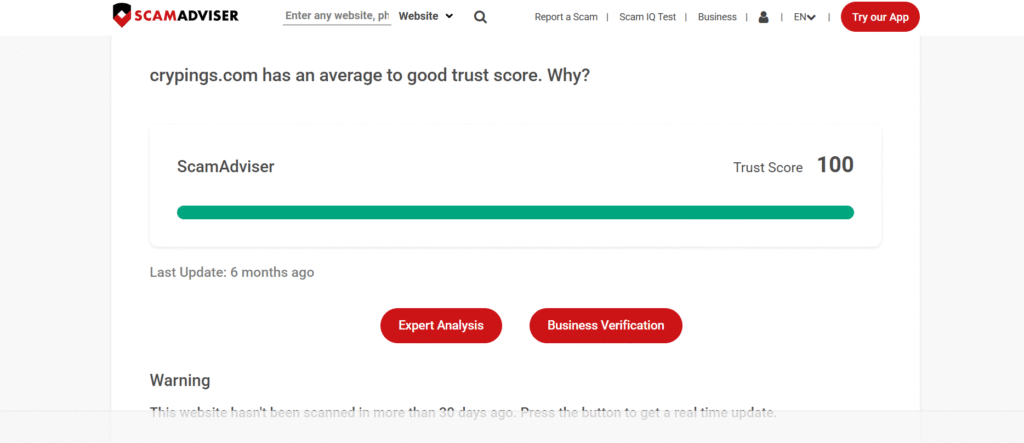
Here’s the honest, unglamorous verdict: there’s no evidence Crypings.com is an active scam, but there’s also nothing here that has earned your trust yet.
I ran it through Scamadviser myself, and it came back with a Trust Score of 100 out of 100, labeled “average to good.” Look closer and the page undercuts its own number: it was last updated six months ago, and Scamadviser flags that the site hasn’t been scanned in over 30 days, so that “100” is a stale snapshot, not a live read.
A 100 score here measures technical hygiene, domain age, a valid SSL certificate, registration history, not content quality. A domain can pass all of that and still publish invented testimonials and contradictory claims about what it even is, which is exactly what I found when I opened the site myself. It tells you Crypings.com probably won’t vanish overnight. It tells you nothing about whether you should believe what it publishes.
On the safer side of the ledger: the site never asks for a password, a wallet connection, or a private key, which structurally limits how much harm it could do even with bad intentions. What it’s missing is any of the following:
- A publicly listed company name or business registration
- Named leadership or an identifiable operating team
- Verifiable traffic numbers from any third-party analytics tool
- Any factual basis for the specific stats other “reviews” cite about it, like coin counts or user numbers
One cautionary review put this well: with no published registration and no named leadership behind it, the responsible move is doing your own checking rather than taking any single review’s word for it. That advice holds regardless of what you personally conclude about this particular site.
Should this site ever get a link from you?
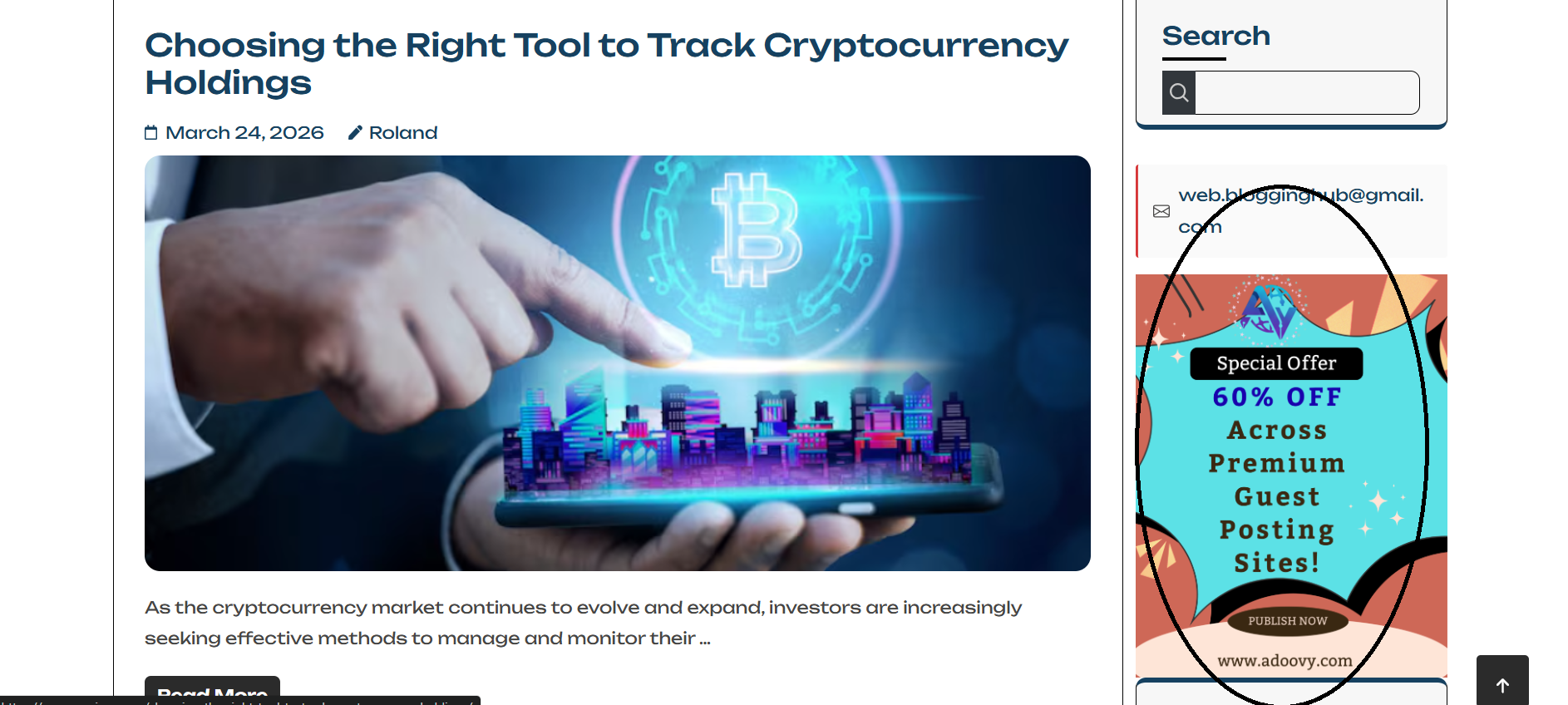
This question matters for a different slice of readers than the crypto-curious ones: anyone evaluating Crypings.com as a guest-post or backlink target.
The sidebar carries a running ad for a service called Adoovy, offering “60% off across premium guest posting sites” with a “Publish Now” button. That’s not a vague hint, it’s the site telling you directly, in its own sidebar, that guest-post and link placement is part of its business model. But be honest about what that placement is actually worth. A domain with no verified crypto authority, no independent traffic data, and a cluster of mass-produced, contradictory reviews attached to its name is close to a textbook case of what Google’s spam policies call scaled content, pages produced primarily to manipulate rankings rather than help a reader, regardless of whether a human or an AI tool wrote them. A link from a site like this carries more downside risk to your own domain’s reputation than upside authority.
If you’re weighing this site against a guest-post opportunity, that’s a decision worth making with your eyes open, not on the strength of a domain-age score.
Five checks I now run on any obscure crypto site
You don’t need a WHOIS subscription for most of this. Before trusting any unfamiliar crypto-adjacent website, run through this list:
- Open the site yourself and look for the specific feature a review describes. Don’t take a description on faith.
- Search the site’s name plus “trustpilot” and “reddit.” Total silence on a site claiming financial features is itself a signal worth noting.
- Check for a named owner or registered company. If it’s absent, treat every other claim on the site with more skepticism.
- Notice when multiple “reviews” read the same. Near-identical structure or phrasing across different domains usually means none of them did original research.
- Never connect a wallet, enter a private key, or send funds based on a blog post’s word alone. Verify independently first, every time.
Run any obscure site through that list and you’ll usually know within a few minutes whether you’re looking at a real product, a content farm, or somewhere in between.
Crypings.com, based on everything I found by actually opening it, lands closer to a low-stakes content blog wearing crypto-flavored branding than any of the platforms described in its “reviews.” It’s not dangerous to visit. It’s just not what half the internet is selling it as, and that gap is worth knowing before you trust a single feature claim about it anywhere else. Next time an unfamiliar crypto site turns up in your search results, run it through the same five checks above before you take any review, including this one, at face value. If you’re building out this kind of due diligence habit, our InstaNavigation safety breakdown walks through the same questions for a different, unrelated tool.
FAQs
Is Crypings.com legit or a scam?
There’s no evidence of an active scam. Automated checkers pass it on domain age and SSL, but it also has no verified owner and no independent reviews anywhere, so treat it as safe to read and not something to trust with money or personal details.
Is Crypings.com a cryptocurrency exchange or wallet?
No. It doesn’t hold funds, process transactions, or require identity verification. Reviews describing wallet, trading, or exchange features are describing things that aren’t on the actual site.
Does Crypings.com have Trustpilot or Reddit reviews?
No. There’s no Trustpilot business profile and no meaningful Reddit presence, largely because the site has no accounts or payments to generate the kind of friction that drives people to leave reviews in the first place.
Why do different reviews describe Crypings.com so differently?
Most of the ranking reviews appear to be produced without anyone actually visiting the site, which is why one calls it an analytics hub, another a wallet, and another a signals service. They can’t all be describing the same product, because they aren’t.
Who owns Crypings.com?
Not publicly confirmed. There’s no published company registration or named leadership beyond a single blog byline and a general contact email in the site’s footer.
Should I place a guest post or buy a link on Crypings.com?
The site openly runs a guest-post marketplace, but it’s a low-authority, mass-content property with no verified audience. Given how Google enforces its scaled content and site reputation policies, links from a site like this carry more risk than benefit.
Is the content on Crypings.com trustworthy?
Not consistently. Posts across its categories share a reused AI-generated hero image and a single generic byline, and at least one health post includes unnamed, uncited “success stories” that read as invented rather than reported. Treat any factual claim on the site as unverified until you check it elsewhere.