
Someone in your class says there is a trick, a bot that joins your Blooket game for you, answers every question automatically, and drops thousands of free tokens into your account. You search it up. There are GitHub links, Discord servers, YouTube videos. It looks real.
Here is the direct answer: Blooket bots do not work as advertised in 2026. Most fail completely, and the ones that partially work are the most dangerous to run. This guide covers what these bots actually are, why they fail technically, how they spread so fast, and what the real risk is, because it is not getting a game ban.
What Is a Blooket Bot?
A Blooket bot is a third-party script or tool, built by outside developers, not by Blooket , that tries to automate or cheat inside a Blooket game. Blooket does not make, approve, or support any of these tools.
Depending on what they claim to do, a Blooket bot might:
- Flood a game lobby with hundreds of fake player names
- Answer every question automatically at impossible speed
- Add free tokens or coins to your account without earning them
- Unlock rare Blooks (character avatars) without paying
- Crash or break an active game session for everyone
Every one of these tools is unauthorized. And as you will see shortly, most of them do not deliver what they promise.
Quick clarification before going further: if you have seen something called a “Bot Pack” inside Blooket itself, that is completely unrelated. The Bot Pack is a legitimate in-game collectible, a set of robot-themed Blook avatars you can buy with tokens. It is a cosmetic item with nothing to do with automation or cheating. Bot Pack = official Blooket item. Bot scripts = unauthorized third-party tools. They share a word and nothing else.
How Does a Blooket Bot Work?
To understand why most bots fail, you need to understand one simple idea: the difference between what your screen shows and what Blooket’s server actually stores.
Think of your Blooket account like a bank account. Your screen is just a window showing your balance. The real money lives in the bank’s vault , Blooket’s server. A bot script running on your device can change what the window displays. It cannot touch the vault.
So when a token bot claims to add 10,000 coins to your account, here is what actually happens:
- The script changes the number you see on screen
- Blooket’s server never receives a valid request
- The moment you refresh the page or the game ends, the number disappears
- Nothing was saved. The server ignored the whole thing.
This is called server-side validation. Blooket checks every action against its own database before saving anything. Scripts on your phone or laptop cannot bypass that check.
Here is how each bot type plays out against that reality:
| Type | What it claims | What actually happens |
| Flood bot / spam bot | Fills lobby with hundreds of fake players | Causes brief disruption; blocked by Cloudflare rate-limiting |
| Answer bot / auto-answer | Answers every question instantly | Flagged by AI behavioral detection within seconds |
| Token bot / coin generator | Adds free tokens to your account | Visual illusion only , server rejects the request entirely |
| Unlock bot | Unlocks rare Blooks without paying | Same as token bot , nothing changes in your real account |
| Crash bot | Breaks the game for everyone | Can occasionally disrupt; most likely type to carry malware |
Flood bots can cause temporary chaos in a lobby before Blooket’s rate-limiting shuts them down. They do not affect scores or earn anyone rewards. Answer bots trigger Blooket’s AI-driven detection immediately , no real human answers every question in under a second with perfect accuracy, and the system knows it. Token bots and unlock bots change your display only; the server never saves the change, and the fake number disappears when the session ends.
Do Blooket Bots Actually Work in 2026?
No, and the reason comes down to one simple fact.
Every Blooket account, token balance, and reward lives on Blooket’s own servers. A bot script runs on your device. Those are two completely separate systems, and a script on your side cannot touch the data on Blooket’s side.
When a token bot claims to add 10,000 coins to your account, it changes the number displayed in your browser nothing more. The moment you refresh the page or the game ends, the number resets. Blooket’s server was never updated because it never received a valid request. The change was always display-only.
The same logic applies across every bot type. Flood bots can briefly fill a lobby with fake names before Blooket’s rate-limiting shuts them down disruptive for a few minutes, but no scores change and no rewards are generated. Answer bots get flagged by behavioral detection because no real human answers every question perfectly in under a second. Token bots, coin generators, and unlock bots all fail at the server level the moment Blooket tries to verify the balance which happens automatically.
The only partial exception is crash bots, which can destabilize an active session. They cause real disruption. They also happen to be the category most likely to carry malicious code inside the script.
Bots can disrupt. They cannot deliver. And the ones that come closest to working are the most dangerous to run.
Why Did Blooket Bots Suddenly Become So Popular?
The answer is not simply that students want to cheat.
Blooket grew rapidly as teachers adopted it for classroom review games. The more competitive the games became, the more motivation students had to find shortcuts. GitHub made discovery effortless , one developer posts a bot script publicly and anyone searching “blooket bot github” finds it within minutes. From GitHub, scripts spread to Discord servers, YouTube tutorials, and Glitch.me-hosted pages where students do not even need to download anything. They click a link in a browser and the tool runs immediately.
Community analysis from late 2025 found Discord became the primary distribution channel, with students describing it as something a classmate mentioned , curiosity-driven, not planned. Scripts also rebrand constantly. Every time Blooket patches a vulnerability, developers rename and reupload. That is why the ecosystem never fully dies. What started as a niche coding experiment became a widely shared classroom problem, not because the bots work well, but because they are trivially easy to find.
Is a Blooket Bot Safe to Use?
No. And this is where the conversation needs to shift.
Most students think about one risk: getting caught and losing their account. That is the least serious outcome. The real danger is what the script does to your device while it runs.
What I actually found when I visited a Blooket bot site
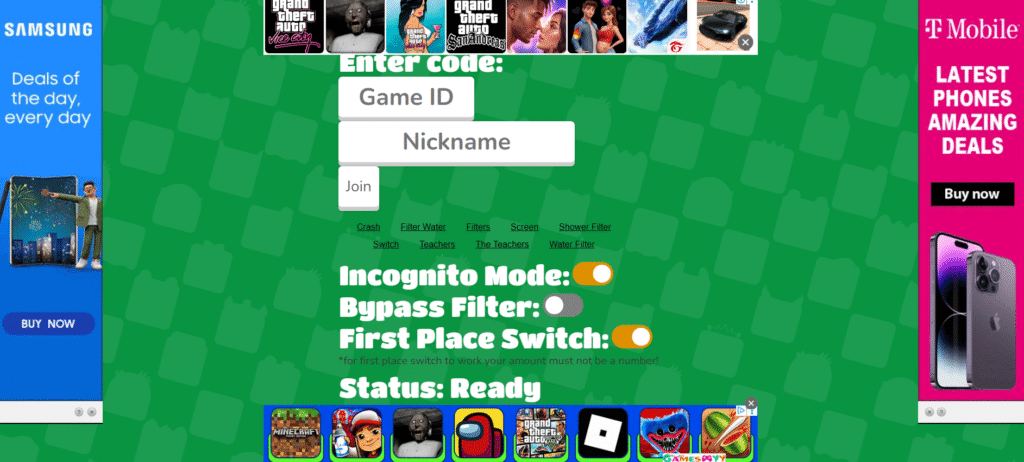
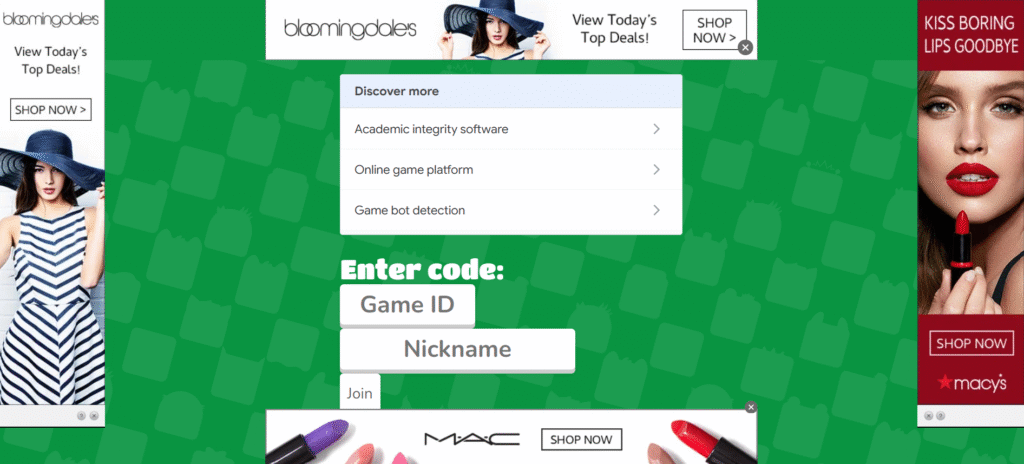
I visited one of the most widely shared Blooket bot sites directly to see what students encounter. The page used Blooket’s exact green color scheme , designed to look familiar. There was a Game ID field, a Nickname box, a Join button. But surrounding it on every side were third-party ads: fashion brands, mobile games, cosmetics. None of it related to Blooket.
Below the form were three toggles that revealed what the site was actually built for:
- Incognito Mode – switched ON by default, specifically to hide bot activity from teachers
- Bypass Filter – designed to get around school network content controls
- First Place Switch – claiming to push the user to first on the leaderboard
These are not features for curious coders. They exist entirely to evade detection from teachers, schools, and Blooket’s own security systems.
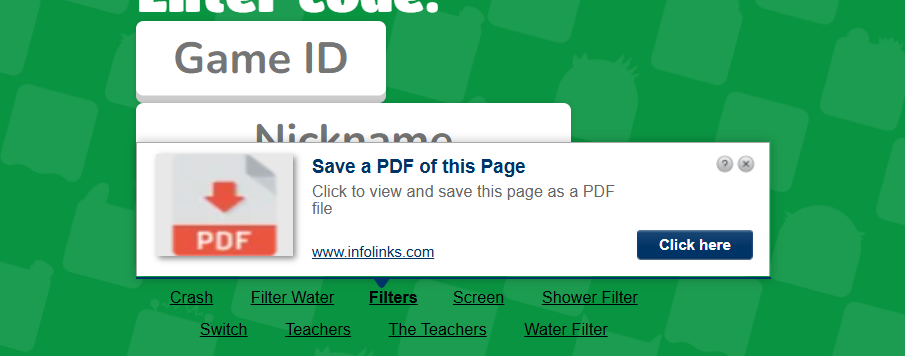
When I hovered over one of the links on the page, a popup appeared: “Save a PDF of this Page.” Clicking it redirected to a third-party PDF converter , completely unrelated to Blooket , with the bot site’s URL fed in automatically. No bot ran. No tool downloaded. The click was the product.
That is the model. The bot interface is the bait. Ad impressions, redirect clicks, and potential data collection are the actual business. A student who lands on this page after a Google search has no obvious reason to think it is not legitimate, because it was designed to look that way.
The malware risk goes further than ad traps. Security testing from Coruzant (November 2025) identified the most common threats hidden inside bot scripts:
- Keyloggers: silently record every keystroke, including passwords typed into email, social media, and any other account on the device
- Trojans: disguised as a useful download; the student thinks they are getting a game tool but are installing a backdoor
- Credential phishing: fake login screens styled to look like Blooket that send your username and password to an outside server
- Browser hijackers: extensions that request broad permissions and use them to track activity across every site you visit
Running any of these scripts on a school device extends the exposure beyond the student’s own accounts to the school’s network.
What Typically Happens When Students Use Blooket Bots
The outcome is predictable and rarely goes the way the student expected.
The most common scenario: a student runs a flood bot during a live class game. The bot causes a few minutes of lobby chaos before Blooket’s rate-limiting shuts it down. The student gains nothing. The teacher ends the session, restarts with a new code, and the class loses ten minutes of review time.
The more serious scenario: a student downloads a script from GitHub or Discord and unknowingly installs malware in the process. The bot does nothing useful. The malware runs silently logging keystrokes, collecting browser data until a school account gets accessed from an unknown location or IT flags the software weeks later.
When Blooket’s detection flags fire, the consequences go beyond a game suspension. Per the Blooket Terms of Service, accounts can be permanently banned for bot use. More importantly, most student accounts are linked to school institutions. Which means Blooket can report the activity directly to school administrators. A game disruption becomes an academic integrity issue, handled the same way as cheating on a test.
Students expected a small, contained risk. The actual outcome was larger, slower to resolve, and more visible than anything they anticipated.
Can Blooket Detect Bots?
Yes, and detection has improved significantly as of 2026.
Blooket uses multiple systems simultaneously to catch bot activity:
- Cloudflare rate-limiting : blocks any device sending too many join requests in a short window
- CAPTCHA verification : automated challenges that scripts cannot pass
- AI behavioral analysis : sub-300ms answer speeds trigger an automatic review flag; no real human answers every question perfectly in under a second
- Server-side validation : rejects every unauthorized reward request before it is recorded
When those flags fire, Blooket can reset scores, suspend the account, or notify school administrators directly if the account is linked to a school institution. Per the Blooket Terms of Service (blooket.com/terms), using automation tools, bots, or unauthorized scripts is an explicit violation that can result in a permanent ban.
From a teacher’s perspective, bot activity is also visually obvious without any tools at all. A student who consistently scores in the bottom third of the class suddenly leading the leaderboard with perfect accuracy and millisecond response times is not a subtle anomaly. Teachers who run Blooket regularly know exactly what normal game data looks like and what it does not.
What Happens to the Teacher’s Data?
This is one of the most concrete harms from bot use, and almost no article covers it.
Many teachers use Blooket scores as a lightweight check on student understanding, a quick signal of who needs extra support before a test. When bot activity floods a game or inflates scores artificially, that data becomes completely unreliable.
Community discussions from late 2025 documented multiple teachers who stopped using Blooket for assessment purposes entirely after a single bot incident corrupted their session data. One flooded game can wipe out a week of progress tracking.
The student running the bot is not just risking their own account. They are breaking a tool their teacher uses to support the whole class.
How Teachers Can Stop Bots Right Now
Five steps that work immediately:
- Enable Student ID Mode, requires players to log in with verified school accounts; blocks all anonymous joins
- Set a player cap, match it to your exact class size before sharing the code
- Use manual start, review the lobby before going live; look for random username strings or obviously fake names
- Share the code verbally, say it aloud in the room, not in a shared chat or posted document
- End and restart immediately if you see flooding, kill the session from the host dashboard, generate a new code, re-enable Student ID Mode before restarting
Student ID Mode is the single most effective step available. It converts an open lobby that anyone with the code can enter into a verified room only your actual students can access.
What Parents Should Know About Blooket Bots
If your child uses Blooket at school, this section is for you.
Blooket is a legitimate classroom tool used by millions of teachers for review games and quizzes. The bots are not part of it , they are third-party scripts shared on Discord, GitHub, and similar platforms. Most students try them out of curiosity after a classmate mentions it, not with serious intent to cheat.
The risk is not just a banned account. A Blooket ban is actually the least serious outcome. The bigger risk is what a bot script can do to the device it runs on. Many scripts contain Trojans or keyloggers that record every password typed on that device after installation , school email, social media, anything saved in the browser.
Signs something may be wrong:
- The browser looks different , new toolbars appeared or search results changed
- The device runs noticeably slower than before
- Your child mentions their Blooket account was banned or suspended
- Unfamiliar extensions appear under Settings then Extensions in Chrome or Edge
What to do if you find a bot script:
- Remove the extension or file immediately
- Run Malwarebytes Free , it catches most keyloggers at no cost
- Change passwords for every account accessed on that device, starting with the school email
- If it was a school-issued device, contact the IT department , self-reporting is always better than waiting to be flagged
The conversation that actually lands with students is not about cheating rules. It is simpler: the person who built that script was not trying to help your child win a game. They were trying to access your child’s device. The game was the packaging. One conversation now is easier than recovering compromised accounts later.
The Bottom Line
Blooket bots do not work the way they are advertised. The game’s real data lives on Blooket’s servers, and a script on your device can change only what you see on screen, it cannot change what Blooket actually records.
The tools that come closest to causing real disruption are also the ones most likely to carry malware. The bot site I visited firsthand confirmed this: surrounded by ads, built with evasion toggles, redirecting every click to generate revenue. The tool is designed to keep a student on the page long enough to be monetized. Everything else is the actual product.
If you are a student who was curious: you now have the honest answer. If you are a teacher dealing with a flooded session: Student ID Mode is your fastest fix. If you are a parent who found something on your child’s device: the steps above will help you act immediately.
For more on AI tools that genuinely support learning, explore the tools directory at TheDiscoverAI.
Frequently Asked Questions
What is a Blooket bot?
A Blooket bot is an unauthorized third-party script not made by Blooket, that tries to automate actions inside a Blooket game, such as flooding lobbies with fake players, auto-answering questions, or generating free tokens. Using one violates Blooket’s Terms of Service and can result in a permanent account ban.
Do Blooket bots actually work in 2026?
No. Blooket stores all tokens, rewards, and game data on its own servers. Scripts on your device can only change what your browser displays locally. The server rejects every unauthorized reward request and never saves the change. Flood bots can briefly disrupt a lobby, but no bot reliably delivers coins, Blooks, or any real in-game benefit.
Is it safe to use a Blooket bot?
No. Many bot tools found on GitHub, Discord, and third-party sites contain malware, keyloggers, or credential phishing traps. Independent security testing by Coruzant (November 2025) found scripts with hidden code designed to steal browser data without the user knowing. The risk extends well beyond a game ban to compromised passwords and device-level exposure.
What is the difference between a Blooket bot and the Blooket Bot Pack?
The Bot Pack is an official in-game collectible robot-themed Blook avatars purchasable with tokens inside Blooket. It has nothing to do with scripts, automation, or cheating. They share one word and are otherwise completely unrelated.
Can Blooket detect and ban bots?
Yes. Blooket uses Cloudflare rate-limiting, CAPTCHA verification, and AI behavioral analysis that flags non-human response patterns, sub-300ms answer speeds trigger an automatic review. When flagged, Blooket can suspend the account or notify school administrators directly if the account is linked to a school institution. All bot use violates the Blooket Terms of Service at blooket.com/terms.
How can teachers stop bots from joining their Blooket game?
Enable Student ID Mode, this is the single most effective step, requiring verified school logins and blocking all anonymous joins. Also set a player cap matching your class size, use manual start to review the lobby before going live, and share the game code verbally rather than posting it anywhere online.
What should I do if my Blooket game gets flooded with bots?
End the session immediately from the host dashboard to stop score data from being corrupted. Generate a new game code. Enable Student ID Mode before restarting. Report repeated incidents to Blooket support if it keeps happening.