
If you’ve landed here, you probably fall into one of two camps: someone weighing a job offer or LinkedIn message from Astera Labs, or someone who noticed ALAB stock has been one of the loudest movers on the Nasdaq this year and wants to know what the company actually does before touching it. Astera Labs builds the connectivity chips that keep AI data centers from bottlenecking, and depending on which of those two camps you’re in, that fact means something very different for you.
This article covers both. What the company builds, why the stock has behaved the way it has, and what the India engineering operation looks like from the inside, based on employee-reported data rather than press releases alone.
Astera Labs at a glance
| Founded | 2017, Santa Clara, California |
| Founders | Jitendra Mohan, Sanjay Gajendra, Casey Morrison |
| Headquarters | San Jose, California |
| Stock | Nasdaq: ALAB (listed March 2024) |
| Employees / offices | 1,000+ employees across 13 global offices |
| India office | Bengaluru, opened late 2024 |
| Q1 FY2026 revenue | $308.4 million (+93% YoY) |
| Recent recognition | EY World Entrepreneur of the Year 2026 (co-founders) |
| Glassdoor rating | 4.5 / 5 |
What does Astera Labs actually make?
Here’s the misconception worth clearing up first: Astera Labs is not an AI company in the sense of building models or chatbots. It’s a semiconductor company that builds the plumbing AI infrastructure runs through.
When a hyperscaler like Microsoft or Google racks up thousands of GPUs to train a model, those chips need to talk to each other and to memory at extremely high speed without data getting corrupted or delayed over distance. That’s the specific, narrow problem Astera Labs solves. Its Intelligent Connectivity Platform includes retimers, smart cable modules, and switches built on standards like PCIe, CXL, and Ethernet, plus a software layer called COSMOS that lets cloud operators monitor and manage all of it at fleet scale.
Put simply: Nvidia and AMD make the processors that do the AI math. Astera Labs makes the components that keep those processors fed with data fast enough that they aren’t sitting idle waiting on a slow connection. In practice, that shows up in three places customers actually buy for: AI server clusters and GPU scale-up racks, general-purpose servers needing memory expansion, and switch-to-switch or switch-to-server networking. It’s an unglamorous, physically-necessary layer of the AI stack, which is exactly why hyperscalers pay for it regardless of which AI model happens to be winning that quarter.
Before any of that ships, it goes through what the company calls its Cloud-Scale Interop Lab: rigorous compatibility testing against major processors, memory vendors, and networking hardware from other companies. That’s a mundane-sounding detail, but it’s the actual reason hyperscalers trust a smaller company for infrastructure this critical: the product has been proven to work with everyone else’s hardware before it’s deployed at scale, not after.
The company frames its own positioning as building for “AI Infrastructure 2.0”: the shift where the entire server rack, not a single chip, becomes the unit that has to be designed and connected as one system. Its newest product, the 320-lane Scorpio X-Series switch, is built specifically for that shift and began shipping to customers in 2026, extending a product line that already spans PCIe, CXL, and Ethernet-based connectivity.
The founder story behind the name
Astera Labs was started in 2017 by three engineers who’d been working together at Texas Instruments: Jitendra Mohan (CEO), Sanjay Gajendra (COO), and Casey Morrison (CTO). They saw that data center connectivity wasn’t keeping pace with how fast AI workloads were scaling, so they quit to build the fix themselves, reportedly out of Gajendra’s garage. The company runs a fabless model (it designs chips but outsources manufacturing to TSMC, the same playbook Nvidia and AMD use), which is how it’s grown to over 1,000 employees across 13 offices while competing against giants with in-house fabs.
The IPO in March 2024 raised roughly $713 million at a $5.5 billion valuation. In May 2026, the three co-founders were named EY World Entrepreneur of the Year, an award that’s previously gone to the founders of Nvidia and Infosys before those companies were household names. Neither fact proves the stock is a good buy, but both are reasonable signals of a credible, well-regarded leadership team.
Astera Labs’ India operations: Bangalore, explained
The India R&D center in Bengaluru opened in late 2024 under Dr. Shivananda Koteshwar, Senior VP and Managing Director of India operations. It’s an end-to-end design center for silicon and connectivity product development, not a support-function outpost. It sits alongside the company’s other engineering hubs (Santa Clara, Toronto, Vancouver, Haifa) as an actual design location.
On compensation and sentiment: Glassdoor and Levels.fyi data (self-reported, treat as directional) show pay bands for India-based hardware roles above typical Bangalore semiconductor averages, with senior hardware compensation running well into seven figures in INR including stock.
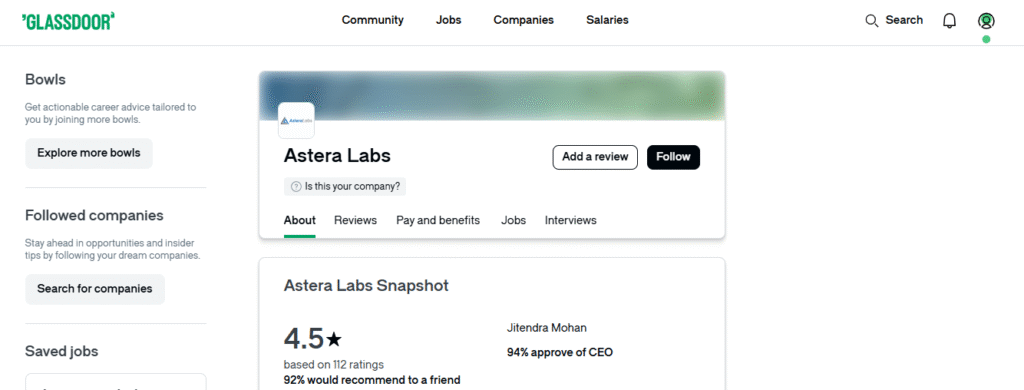
Astera Labs holds a 4.5 out of 5 rating on Glassdoor across 112 reviews, with 92% of reviewers recommending it to a friend. The company also runs a dedicated early-career and internship program (interview difficulty rated moderate, around 3.1 out of 5), so it’s not exclusively a senior-hire operation, and its careers page lists standard benefits (medical, dental, vision, parental leave, retirement plans) worth checking against any offer.
Worth noting for US-based readers: public compensation and sentiment data is simply thinner for the Santa Clara, Toronto, Vancouver, and Haifa offices than for Bengaluru, not because those roles are less substantive, but because India-focused platforms like Glassdoor and Levels.fyi see more review volume from Indian tech hiring markets. A US applicant should expect to lean more heavily on direct recruiter conversations and site-specific research for comp benchmarking.
Why has Astera Labs stock moved so much?
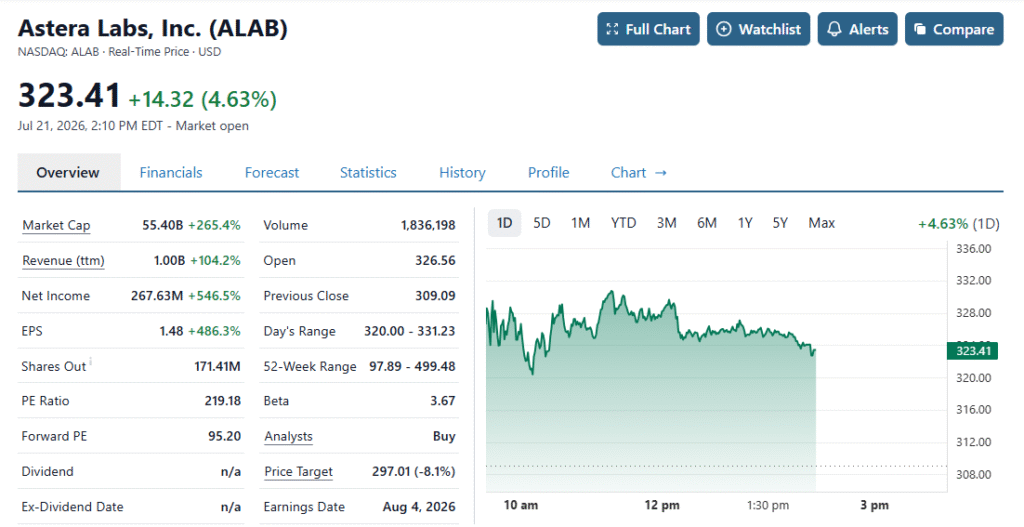
ALAB stock has had one of the more dramatic runs on the Nasdaq over the past year, and the reason is straightforward: revenue growth. The company posted Q1 FY2026 revenue of $308.4 million, up 93% year-over-year, driven largely by demand for its newer Scorpio switch product line and PCIe 6 portfolio. Management guided Q2 revenue to $355-365 million, roughly 88% year-over-year growth, with non-GAAP EPS of $0.68-$0.70.
Growth alone doesn’t explain a stock that has traded at a price-to-earnings ratio well above 200 for most of the past year. That’s a valuation that assumes years of continued hypergrowth, and it’s worth understanding before treating any given price as a floor. The stock’s own recent behavior makes the point: ALAB has swung between roughly $98 and $499 over the past 52 weeks, and single trading days have moved the price double digits in percentage terms in either direction as the market recalibrates its growth expectations around each earnings report.
A framework for reading it, not a prediction:
- If you’re evaluating the business: revenue growth, gross margin (76%+, genuinely strong for semiconductors), and expanding hyperscaler relationships are real, verifiable positives.
- If you’re evaluating the stock price: the trailing P/E sits at 219 and the forward P/E at 95, meaning the market is already pricing in a near-doubling of earnings this year. Wall Street’s average price target has recently sat around $297, below where the stock is actually trading, a sign analysts have been playing catch-up rather than leading the move. The next earnings report, expected August 4, 2026, is the kind of event that has moved the price by double digits in a single session before.
- These are two different questions. “Is it a good company” and “is it a good price to buy at” are not the same evaluation, and conflating them is the most common mistake in how people research stocks like this.
Common mistakes people make researching this company
Assuming “AI company” means the same thing everywhere. Astera Labs gets grouped into “AI stocks” lists constantly, but it has zero exposure to whether any specific AI model succeeds. It’s exposed to whether data centers keep getting built, a related but distinct bet.
Treating Glassdoor’s 4.5 rating as the whole picture. It’s a genuinely strong score, but it’s built on roughly 112 reviews for a company with hundreds of employees globally. That’s a meaningful sample, not a comprehensive one. Read a handful of the actual written reviews, not just the star average, before deciding.
Confusing stock momentum with company quality. The past year’s chart is not a substitute for reading the actual quarterly numbers. Rapid revenue growth is real and worth taking seriously; a fast-moving stock price without that underlying growth would not be.
Ignoring the customer concentration risk. Like most semiconductor suppliers to hyperscalers, Astera Labs’ revenue depends on a relatively small number of very large customers. That’s disclosed in its filings and worth understanding if you’re looking at this as an investment rather than an employer.
Overlooking the competitive threat from bigger players. Broadcom and Credo compete directly in connectivity chips, and the more significant long-term risk is hyperscalers designing more of this connectivity in-house rather than buying it, the same trend that’s reshaped other parts of the AI chip stack. That risk doesn’t show up in the growth numbers until it does.
Two quick scenarios
A software engineer in Bangalore with 4 years of experience, evaluating an offer: The India R&D site has strong employee sentiment data and is structured as a full design center. The reasonable next step is comparing the specific offer against Levels.fyi bands for the exact role and level, not the company-wide average, since compensation varies significantly by function.
A retail investor in India using an app like INDmoney to consider a small ALAB position: The business fundamentals (revenue growth, margins, hyperscaler demand) are strong and verifiable. The valuation is priced for continued hypergrowth. The reasonable next step is deciding how much of that growth assumption you’re comfortable paying for today, not whether the underlying business is legitimate. It clearly is.
If you’re researching Astera Labs as a potential employer, start with the specific role’s compensation band on Levels.fyi rather than the company average. If you’re researching it as an investment, read the actual quarterly filing before the stock chart, and the company’s own about page and resources hub are useful primary sources for anything this article doesn’t cover. Either way, you now know what the company does and why it’s suddenly everywhere, and that’s the part most of the existing coverage skips.
FAQs
What exactly do Astera Labs do?
Astera Labs designs semiconductor chips and software that keep data moving quickly and reliably between processors, memory, and storage inside AI data centers. Its main product lines are PCIe/CXL retimers, smart cable modules, and switch fabric chips, paired with a management software suite called COSMOS. It doesn’t build AI models or GPUs. It builds the connectivity layer those GPUs depend on.
Is Astera Labs a good company to work for?
Based on available employee data, yes. Astera Labs holds a 4.5 out of 5 rating on Glassdoor from 112 reviews, with 92% of reviewers recommending it to a friend. Treat the aggregate score as a strong signal rather than a guarantee for your specific team or manager.
Is Astera Labs stock overvalued right now?
Not publicly confirmed as a fact, since valuation is a matter of judgment, not a verifiable yes/no. What’s verifiable is that ALAB has traded at a price-to-earnings ratio well above 200, which historically reflects a market pricing in years of continued rapid growth rather than current earnings alone. The stock has also been unusually volatile, trading anywhere between roughly $98 and $499 over the past year.
Does Astera Labs hire freshers or only senior engineers?
Yes. The company runs a dedicated Early Career Programs track alongside senior hiring, both globally and at its Bengaluru site, and its careers page explicitly frames growth as non-linear, meaning new graduates aren’t boxed into one track. Interview difficulty is rated as moderate by candidates on Glassdoor, around 3.1 out of 5.
Astera Labs vs a company like Marvell Technology: how do they compare?
Marvell is a much larger, more diversified semiconductor company covering networking, storage, and custom silicon across many end markets, while Astera Labs is a smaller, more focused pure-play on AI data center connectivity. That focus is part of why Astera Labs has posted faster percentage revenue growth recently, though Marvell’s scale and diversification make it a fundamentally lower-risk business by comparison.
When did Astera Labs go public?
Astera Labs listed on the Nasdaq under the ticker ALAB in March 2024, raising roughly $713 million in its IPO at a valuation of about $5.5 billion at the time.
Where is Astera Labs headquartered, and does it have offices in India?
The company is headquartered in San Jose, California, and tripled the size of that campus in 2025. It opened a dedicated R&D center in Bengaluru, India in late 2024, which functions as a full silicon design site rather than a support office.