

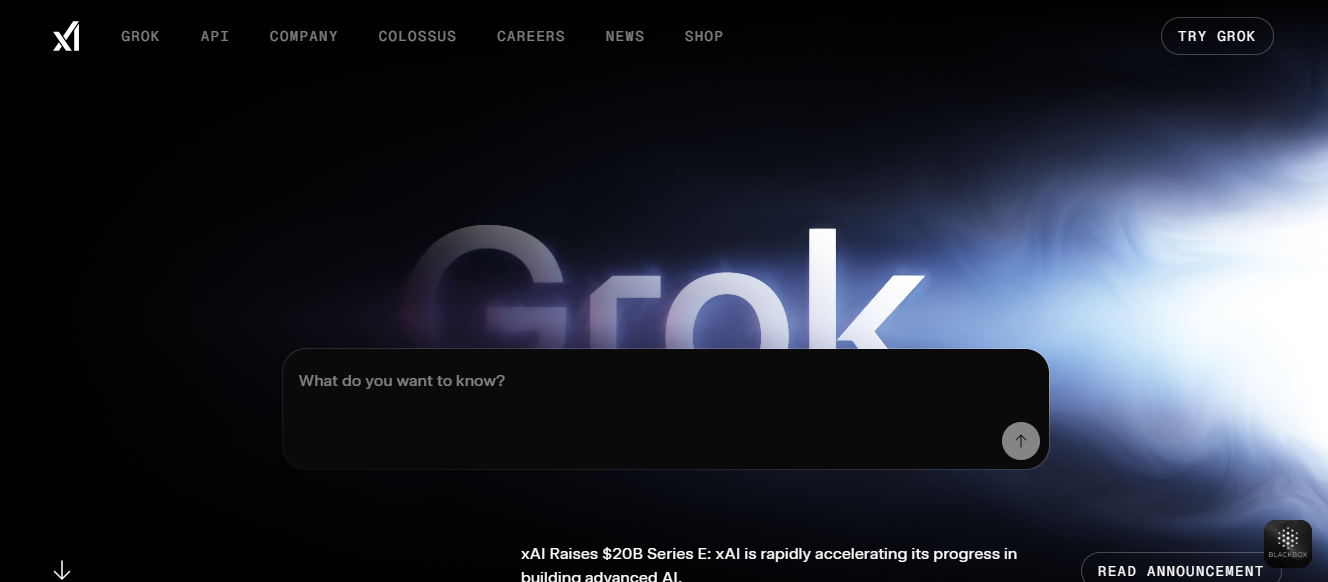
What Is Grok?
Grok is an AI assistant built by xAI that combines a conversational chat interface with live access to X (formerly Twitter) data and real-time web search, a combination no other mainstream AI offers at this price. It solves the problem of working with stale AI output: every conversation can pull current information from the web and the X feed without switching tools. On the SuperGrok plan, you can run a DeepSearch query that cross-references dozens of live sources, or load a 2-million-token document into a single session for analysis.
Key Features
- 2-million token context window: Processes entire codebases or roughly 1,500 pages of text in one session
- DeepSearch: Fires an iterative retrieval loop across the web and X, consulting up to 10 search steps per query with visible reasoning steps
- Big Brain Mode: Activates multiple AI agents working in parallel on a single problem, each approaching it from a different angle before synthesizing one answer
- Grok Imagine: Image and video generation; SuperGrok includes unlimited image generation and approximately 100 video renders per day
- Grok Build Beta: A terminal-native coding agent included with SuperGrok, launched May 2026, designed for multi-step coding tasks across files
Pricing
| Plan | Price | Key Limit / Note |
| Free | $0 | ~10 prompts every 2 hours; text only; no image or video generation |
| SuperGrok Lite | $10/month | Basic image and video at 480p; 1 AI agent; no full DeepSearch or Big Brain mode |
| SuperGrok | $30/month or $300/year | Full DeepSearch, Big Brain mode, unlimited images, Grok 4 access |
| SuperGrok Heavy | $300/month | Only tier with confirmed Grok 4.3 access from launch |
| Grok Business | $30/user/month | Team collaboration, centralized billing, workspace admin controls |
| Enterprise | Custom | Custom SSO, data isolation, SLAs |
Verify current generation caps at grok.com/plans before purchasing, as limits have changed without notice.
How It’s Typically Used
This workflow reflects how a researcher or analyst uses Grok on SuperGrok:
Step 1: You open grok.com or the Grok mobile app and start a conversation without any account setup or configuration.
Step 2: You type a research question, paste a URL to summarize, or upload a document up to 2 million tokens long, such as a full codebase, legal archive, or year of earnings reports.
Step 3: You toggle DeepSearch on, which runs up to 10 iterative searches across live web sources and X posts simultaneously, showing its intermediate reasoning in a visible “Thoughts” panel before generating the final response.
Step 4: Grok returns a cited, multi-source summary with inline links distinguishing web sources from X posts. For complex multi-step problems, you switch to Big Brain Mode, which routes the query through multiple agents working in parallel before synthesizing one answer.
Step 5: You copy the output into a report, competitive brief, or client deck. Follow-up prompts refine specific sections, narrow scope, or pull in a new angle without restarting the session.
Pros & Cons
Pros
- Only mainstream AI that searches X (Twitter) posts alongside web sources in a single query
- 2-million token context window is the largest available in any frontier model as of 2026, double most competitors
- API pricing for Grok 4.1 Fast starts at $0.20 per million input tokens, among the lowest for a frontier-class model
- Multiple independent tests in 2026 rank Grok among the fastest frontier models for inference speed
- Free tier provides genuine access to real-time search and X data without requiring a paid plan
Cons
- Server reliability is a documented problem; “high demand” errors occur multiple times per week even on paid SuperGrok
- Think Mode increases summarization hallucination rates; Grok 4 fast-reasoning scored 20.2% on the Vectara New Dataset, the highest of any frontier model tested
- Trustpilot reviewers report that image and video generation hits undisclosed soft caps well below advertised limits; one annual subscriber described receiving roughly 10 videos and 10 images per week on the $300/year plan
- SuperGrok costs $10 more per month than ChatGPT Plus and Claude Pro, with no clear feature advantage for users who don’t need X data or the large context window
- Content moderation is inconsistently enforced; Grok’s NSFW policies triggered regulatory investigations in over 12 countries in early 2026, making it a poor fit for regulated industries or team environments with minors
Who It’s For
Journalists, researchers, and analysts who need real-time social and web data in one place.
Limited fit for long-form creative writers; independent reviewers consistently rate Claude and ChatGPT higher for narrative writing quality.
Should avoid: teams in regulated or formal environments where Grok’s less-filtered tone and inconsistent content policies create compliance risk.
Is It Worth It?
If your work depends on what’s happening right now, tracking a breaking story, monitoring competitor sentiment on X, or synthesizing a market report from live data, SuperGrok at $30/month is the only consumer AI that does this natively. DeepSearch is also the only major deep research tool that searches X posts alongside traditional web results, which justifies the $10 premium over ChatGPT Plus and Claude Pro for that specific use case.
If you need an AI for long-form writing, careful reasoning, or enterprise reliability, the math changes. For coding tasks, Claude Code and dedicated coding tools remain superior, and the hallucination risk in Think Mode means you will need to verify outputs before relying on them. At $30/month, ChatGPT Plus or Claude Pro deliver more predictable output for those tasks at $10 less.
Grok Alternatives
If you need X-native social research, Grok is the only mainstream option. If you don’t, ChatGPT, Claude, Perplexity AI, and Google Gemini each cover the gap from a different angle.
| Tool | Core Strength | Best Use Case | Starting Price | Key Limitation |
| Grok | Only AI with live X + web search combined | Real-time social research, trend analysis | Free / $10/mo | Unreliable generation caps; Think Mode hallucination risk |
| ChatGPT | Broadest plugin ecosystem; polished writing output | Content creation, versatile professional tasks | $20/mo (Plus) | No native X data access |
| Claude | Best long-form writing and careful reasoning | Document analysis, structured writing | $20/mo (Pro) | No real-time web search on base plan |
| Perplexity AI | Web research with cited sources per query | Fact-checking, sourced research reports | Free / $20/mo (Pro) | No X data; no image generation |
| Google Gemini | Deep Google Workspace integration | Teams already using Google tools | Free / $19.99/mo (Advanced) | Weaker for non-Google workflows |
FAQs
Is Grok free to use?
Yes. Grok’s free tier provides basic chat with real-time web and X search, but image and video generation moved to paid plans in March 2026. The free tier limits you to roughly 10 prompts every two hours.
Does Grok outperform ChatGPT for research tasks?
It depends on the source. For topics where X discourse is part of the story, such as breaking news, crypto, product launches, or market sentiment, DeepSearch surfaces real-time social data that ChatGPT and Perplexity cannot access. For academic or non-social topics, ChatGPT’s Deep Research mode pulls from a broader web source pool.
Is SuperGrok worth $30/month?
SuperGrok costs $10 more per month than ChatGPT Plus or Claude Pro, which makes it worth the premium specifically when you value Grok’s X data connection, DeepSearch, Grok Build, or the 2-million token context window. For general writing or reasoning tasks, the $20/month alternatives are competitive.
Does Grok have a business plan?
Yes. Grok Business is $30/user/month and includes team collaboration, centralized billing, workspace admin controls, and a guarantee that your data will not be used for model training. Enterprise plans with custom SSO and data isolation are available at custom pricing.
Is Grok reliable enough for daily professional use?
Server reliability is a known issue. Paid SuperGrok users reported repeated “high demand” errors and mid-generation failures throughout April 2026, with xAI’s status page showing “fully operational” during the outages. Teams that need consistent uptime should evaluate this against their tolerance for interruptions.