

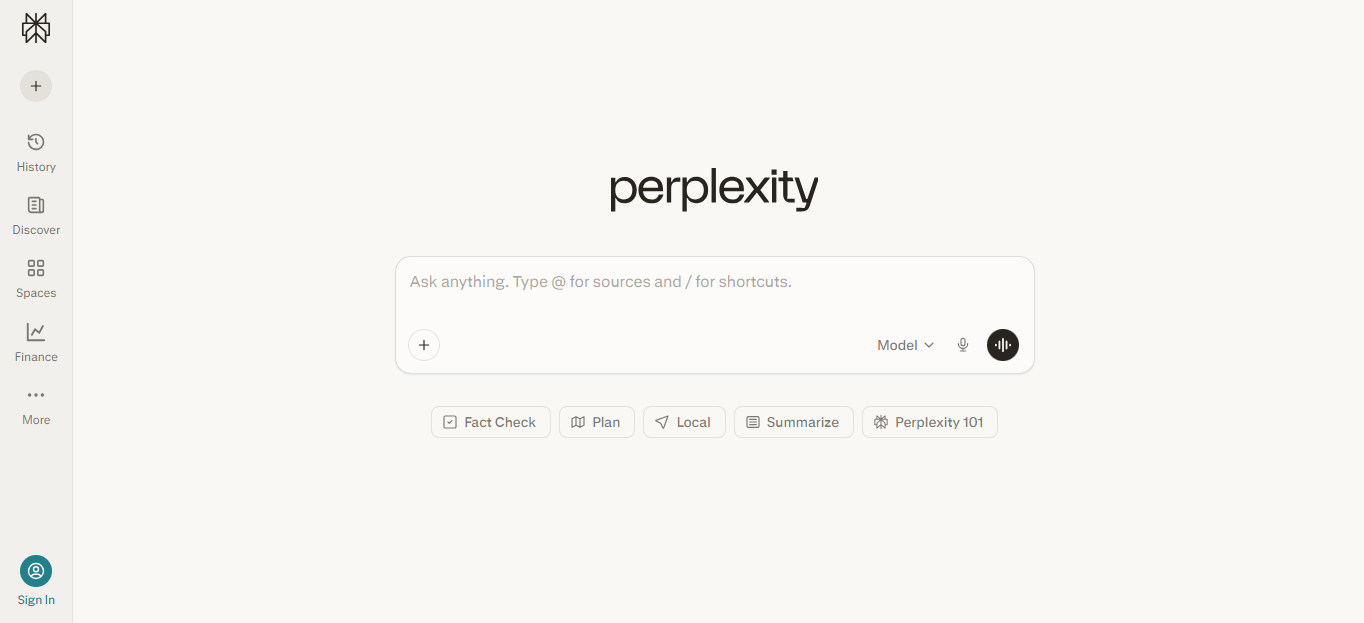
What is Perplexity AI?
Perplexity AI is an AI-powered answer engine that combines large language models with live web search to generate direct, cited answers instead of a list of links. Every response carries numbered inline citations, so a user can click through and verify the exact source behind any claim.
It solves the problem of digging through SEO-heavy search results for a straight answer. A user asks a question, gets a synthesized response with sources, and keeps refining it in the same thread. It’s available on web, iOS, Android, the Comet browser, and via API.
Key Features
- Pro Search: Breaks a complex question into sub-queries, reads across multiple sources, and reasons through the material before answering. Free users get a limited number of uses per day; Pro removes the cap.
- Deep Research: Runs dozens of searches across hundreds of sources and writes a structured report with an executive summary, key findings, and citations, typically in under 5 minutes.
- Spaces: Project folders where a user uploads their own documents alongside live web search. Every query inside a Space checks both the uploaded files and live web data together.
- Model switching: Pro and Max users can pick from, or let Perplexity auto-route between, its own Sonar models and third-party models including GPT, Claude, Gemini, and Grok in the same thread.
- Perplexity Pages: Converts any research thread into a formatted, shareable article with citations preserved, published to a public URL, without needing to reformat anything in a separate tool.
Pricing
| Plan | Price | Billing | Who It’s For | What’s Included |
| Free | $0 | N/A | Casual, occasional research | Core search, chat, limited Pro Search and Deep Research uses per day |
| Pro | $20/mo or $200/yr (~$16.67/mo) | Monthly or annual | Daily researchers, writers, analysts | Unlimited Pro Search, Spaces, file uploads, model switching, image generation |
| Max | $200/mo or $2,000/yr | Monthly or annual | Power users running research and Labs daily | Everything in Pro, plus Model Council, higher Labs limits, priority access to new features |
| Education Pro | $10/mo | Monthly | Verified students (SheerID) | Same feature set as Pro at half price |
| Enterprise Pro | $40/user/mo | Monthly or annual | Small to mid-size teams | Pro features plus SSO, shared Spaces, admin dashboard, SOC 2 compliance |
| Enterprise Max | $325/user/mo | Monthly or annual | Research-intensive organizations | Enterprise Pro features plus expanded audit logs, custom data retention, dedicated account manager |
Prices confirmed against Perplexity’s own pricing pages as of mid-2026. Tiers have shifted more than once this year, so check perplexity.ai/pricing before committing to an annual plan.
How People Actually Use It
- Ask directly. A user opens Perplexity on web, mobile, or the Comet browser and types a question straight into the search bar. There’s no need to pick a model first since Perplexity auto-routes simple queries.
- Switch modes for depth. For a multi-part question (comparing pricing across regions, for example), the user switches to Pro Search, which breaks the question into sub-searches and reads across sources before responding.
- Bring in their own material. For an ongoing project, they create a Space and upload relevant files, like a competitor’s earnings report or a client’s brief. Every question asked inside that Space checks both the uploaded documents and live web data at once.
- Go deeper when needed. For a full investigative task, the user runs Deep Research, which performs dozens of searches across hundreds of sources and returns a structured report with an executive summary in a few minutes.
- Refine without starting over. They ask follow-up questions in the same thread to narrow the focus, since Perplexity keeps the full conversation context.
- Turn research into a deliverable. Once the research is solid, they either convert the thread into a Page for a shareable, formatted article, export a Deep Research report as a PDF, or switch to Labs to generate an actual dashboard, spreadsheet, or slide outline from the findings.
- Publish or hand off. The final output gets dropped into a report, a blog draft, a client deck, or a team knowledge base, with the original citations intact for anyone who wants to verify the source.
Pros & Cons
Pros
- Cites sources inline with clickable links, so claims are checkable rather than taken on faith
- Model Council lets Max users cross-check an answer across three frontier models at once
- Spaces cross-reference a user’s own uploaded documents against live web data in the same query
- Comet browser is free and can summarize or act on the page a user is currently viewing
- One subscription covers model access that would otherwise mean paying for several separate AI tools
Cons
- Perplexity cut Pro-tier Deep Research quotas sharply in early 2026, some users went from roughly 250 reports per day to about 20 per month with little advance notice
- Occasionally cites informal sources like forum posts without flagging them as such
- Facing active lawsuits from major publishers over content scraping, plus a separate complaint about sharing user data with third parties, worth knowing for anyone in a regulated field
- Free plan’s daily Pro Search and Deep Research caps are tight for anyone doing more than casual lookups
- An answer is only as reliable as the source behind it, so a low-authority citation can still mislead even when properly linked
Who It’s For
Best fit: knowledge workers, analysts, and writers who need fast, sourced answers and want to fold their own documents into the research.
Limited fit: heavy Deep Research users, since the 2026 quota cuts make high-volume workflows less predictable than before.
Should avoid: teams in regulated industries needing airtight data governance, given the pending third-party data-sharing complaint.
Is It Worth It?
If a user researches daily and wants cited, verifiable answers without juggling multiple AI subscriptions, Pro at $20/month is competitive with any other $20 AI plan and pays for itself quickly, especially once Spaces and Pages enter the workflow.
It’s a weaker fit if the workflow depends on heavy, predictable Deep Research volume, since recent quota reductions have made that use case less reliable, or if the organization needs firm answers on data handling before the pending litigation resolves.
Perplexity Alternatives
ChatGPT, Google AI Pro, and Phind are the tools most often compared to Perplexity, with each one better suited to a different type of user or workflow.
| Tool | Core Strength | Best Use Case | Starting Price | Key Limitation |
| Perplexity | Cited, web-grounded answers with document cross-referencing | Research and fact-checking with your own files | Free; Pro $20/mo | Recent Deep Research quota cuts |
| ChatGPT | Broader general-purpose and creative range | Writing, coding, brainstorming | Free; Plus $20/mo | Citations less consistent unless browsing is explicitly enabled |
| Google AI Pro | Deep integration across Gmail, Docs, and Workspace | Users already living inside the Google ecosystem | Free; $19.99/mo | Less citation-first than Perplexity |
| Phind | Developer-focused code search with citations | Debugging and technical documentation lookup | Free tier; paid from ~$17/mo | Narrow focus, not built for general research |
FAQs
Does Perplexity AI cite its sources?
Yes, every response includes clickable inline citations linking to the original source. Users are still advised to check citations on high-stakes claims, since the underlying source can occasionally be wrong even when cited correctly.
Is Perplexity Pro worth $20 a month compared to ChatGPT Plus or Google AI Pro?
All three cost about the same, so the decision comes down to whether cited, document-aware answers (Perplexity) matter more than broader creative tools (ChatGPT) or ecosystem integration (Google AI Pro).
Did Perplexity reduce its Deep Research limits in 2026?
Yes, Perplexity cut some Pro-tier Deep Research allotments from roughly 250 reports per day to about 20 per month in early 2026. The feature wasn’t removed, just quota-limited and relabeled as “Research” mode.
Is Perplexity’s Comet browser free?
Yes, Comet has been free on Mac, Windows, iOS, and Android since March 2026, after launching as a paid, Max-exclusive feature in 2025.
Can Perplexity replace a traditional search engine?
It can reduce time spent browsing multiple tabs for straightforward research questions, but it doesn’t eliminate the need for independent verification, especially on niche or high-stakes topics.